
July 4, 1776: The day Thomas Jefferson went shopping
July 4, 1776: A Day of Contrasting Histories
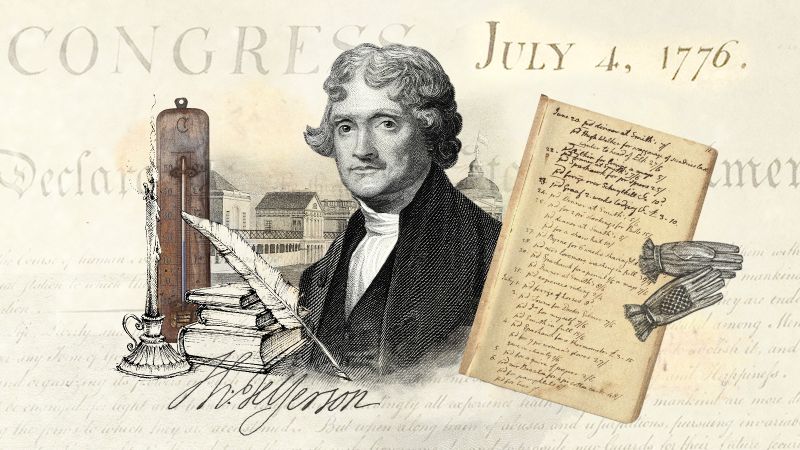
July 4 1776 – On the morning of July 4, 1776, the skies over Philadelphia were clear, with a cool 68-degree breeze marking the start of what would become a pivotal day in American history. By midday, the temperature had climbed to 72.25 degrees, reaching a mild 76 by 1 p.m., before settling slightly to 73.5 degrees in the evening. These precise measurements, documented by Thomas Jefferson himself, offer a unique glimpse into the daily rhythms of a man whose words would shape a nation. While the Continental Congress was finalizing the Declaration of Independence—a document that would sever the United States from British rule and spark global change—Jefferson was preoccupied with a different task: purchasing a thermometer.
The Unlikely Intersection of Revolution and Routine
Jefferson’s meticulous nature extended beyond politics and philosophy. According to his personal account books, the day began with a routine activity: buying a thermometer from John Sparhawk, a local apothecary and bookseller on Second Street. The instrument cost three pounds and 15 shillings, a sum that suggests Jefferson was not only keen on tracking weather but also investing in a tool that would aid his work. This transaction, recorded alongside other expenditures, reveals a side of Jefferson often overlooked—his ability to balance monumental responsibilities with everyday chores.
Alongside the thermometer, Jefferson spent 17 shillings on seven pairs of women’s gloves, a detail that highlights the practicality of his actions. He also gave one shilling and six pence to charity, a gesture that underscores his commitment to civic duty even during moments of personal convenience. The question remains: why did Jefferson, the principal author of the Declaration of Independence, dedicate time to these seemingly mundane purchases on a day that would be remembered as the birth of a nation?
Revisiting the Significance of July 4, 1776
Andrew Davenport, vice president of research at Monticello, Jefferson’s estate, offers a compelling perspective: “It’s a mundane day, except it’s a revolutionary one.” He emphasizes that the Declaration of Independence was not finalized on July 4, but rather adopted on that date. The actual resolution for independence was passed on July 2, a decision that John Adams famously deemed “the most memorable Epocha in the History of America.” Adams, in a letter to his wife Abigail on July 3, envisioned a grand celebration, with “Pomp and Parade, with Shews, Games, Sports, Guns, Bells, Bonfires and Illuminations” marking the occasion.
“It ought to be commemorated, as the Day of Deliverance by solemn Acts of Devotion to God Almighty,” Adams wrote. “It ought to be solemnized with Pomp and Parade, with Shews, Games, Sports, Guns, Bells, Bonfires and Illuminations from one End of this Continent to the other from this Time forward forever more.”
Jefferson’s actions on July 4, however, suggest that the day was not as momentous in the eyes of the man who drafted the Declaration. James P. McClure, general editor of the Papers of Thomas Jefferson project, notes that the formal approval of the document occurred in the morning, with the Continental Congress likely completing the task by midday. This timeline implies that the final moments of the Declaration’s creation were already behind them, leaving Jefferson with time to attend to personal errands.
The Role of Daily Life in Founding a Nation
Jefferson’s ability to juggle political and personal responsibilities raises intriguing questions about the nature of revolutionary activity. Cara Rogers Stevens, a Jeffersonian scholar at Ashland University, proposes that his focus on daily tasks might have been due to his lighter workload compared to other Congress members. “The fact that he was able to run a few errands on the same day maybe indicates that he wasn’t on as many committees as some of the other members of Congress, like John Adams,” Stevens explains.
While the Declaration’s adoption is widely celebrated, McClure reminds us that the day itself was more of a culmination than a beginning. The Continental Congress had spent months debating, revising, and finalizing the document, with Jefferson and Robert Hemmings, an enslaved teenager who assisted him, playing key roles. The committee that drafted the Declaration, appointed on June 11, submitted their work to Congress on June 28, allowing for a final review before the July 4 vote. This process underscores the collaborative effort behind the nation’s founding, rather than the solitary genius of any one individual.
Jefferson’s thermometer purchase, though small in scale, symbolizes a broader truth: even during times of historic transformation, ordinary tasks persist. Davenport highlights this duality, stating, “It’s a reminder for us that even during the most frenetic times in our history, that daily business still needs to be attended to. And daily business is the fabric of civic life, and civic life, of course, is the fabric of the nation.” The act of measuring temperature, buying gloves, and giving to charity becomes a metaphor for the quiet resilience that underpins societal change.
Contextualizing the Revolution’s Pace
Historians often grapple with the perception of July 4, 1776, as a defining moment. Yet, as McClure points out, the day was part of a longer, more complex sequence of events. The Continental Congress had already spent over a year in deliberation, balancing the demands of rebellion with the intricacies of governance. By July 4, the groundwork for independence was laid, and the final approval of the Declaration was merely the next step in a process that had been months in the making.
This nuance challenges the traditional narrative of July 4 as an instant of dramatic change. Instead, it paints a picture of sustained effort and incremental progress. Jefferson’s temperature logs, once dismissed as trivial, now serve as a testament to the man’s dedication to detail. His spending spree on the day of the Declaration’s adoption—purchasing a thermometer, gloves, and contributing to charity—highlights how the revolutionaries of the era navigated the tension between grand ideals and everyday realities.
Ultimately, the story of July 4, 1776, is not just about the birth of a nation but also about the people who built it. Jefferson’s actions remind us that the founding of the United States was not a single, dramatic event but a series of interconnected decisions, both monumental and mundane. The thermometer he bought that day, now a historical artifact, stands as a symbol of the intersection between personal life and public history. It invites us to reconsider the significance of ordinary moments in shaping extraordinary legacies.
As we reflect on July 4, 1776, we are reminded that the path to independence was paved by countless small acts. From the careful recording of temperatures to the purchasing of gloves, these details reveal a man deeply engaged in the business of creating a new nation. While the world remembers the Declaration’s adoption, it is the quiet persistence of daily life that ultimately sustained the revolution—a truth that Jefferson’s shopping spree quietly underscores.
