
‘Leave or return in a coffin’: The threat driving migrants out of South Africa
‘Leave or return in a coffin’: The threat driving migrants out of South Africa
The Ultimatum on the Doorstep
Leave or return in a coffin – For months, anti-migrant rhetoric had been growing in South Africa. Then, it reached Kaunga Nyirenda, a Malawian gardener living in a Johannesburg suburb. In early June, two men delivered a chilling ultimatum to him: depart immediately or risk death. Nyirenda recounted the encounter, saying the individuals told him, “When are you going to leave the country? We want to fix our country. If you don’t leave now, you’re going to leave in a coffin because we don’t need anyone after the 30th of June.”
“When are you going to leave the country? We want to fix our country. If you don’t leave now, you’re going to leave in a coffin because we don’t need anyone after the 30th of June.”
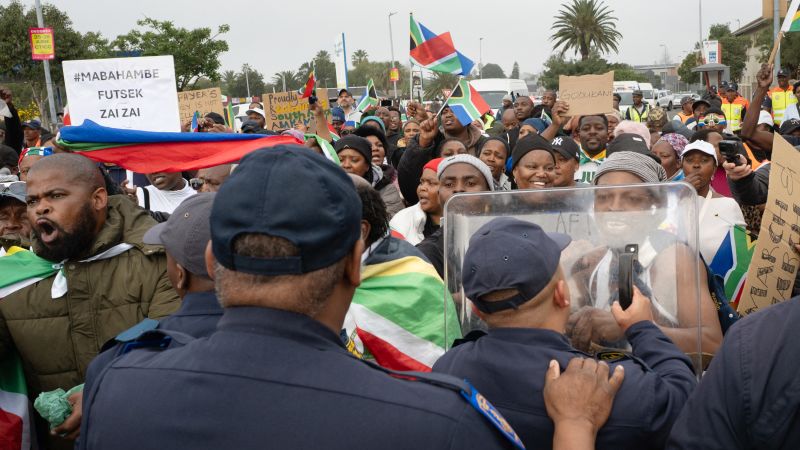
Nyirenda’s encounter highlights a rising tide of xenophobic sentiment across the nation. Recent weeks have seen protest groups and self-proclaimed vigilantes, claiming their demonstrations are peaceful, ignite incidents that have led to attacks on both documented and undocumented foreigners. These groups accuse immigrants of taking jobs, committing crimes, and overburdening public services. The fear of a violent climax by the end of June has intensified, with some activists demanding immediate action against foreign nationals.
Government Denies the “Deadline”
The South African government has dismissed the so-called “deadline” set by anti-migrant groups for foreigners to leave the country. President Cyril Ramaphosa has warned that security forces are preparing to manage any unrest, emphasizing that the government will not allow destabilization efforts by anyone, whether through marches or other means. He has criticized attacks on foreign nationals, stating they do not represent the views of the broader population or the official policy of his administration.
“June 30 is the deadline, but you don’t have to wait until then – leave now.”
Ramaphosa accused opportunists of exploiting the legitimate concerns of South Africans, particularly those in disadvantaged communities, under the guise of “community activism.” He argued that the violence stems from individuals using the issue to advance their own agendas, rather than reflecting a unified national stance. Despite the government’s reassurances, the situation remains volatile as tensions mount in informal settlements and impoverished neighborhoods.
Violent Incidents Spark Investigations
As the June 30 deadline approaches, the exodus of migrants continues. Police have launched inquiries into the recent murders of several foreign nationals, with some cases linked to xenophobic attacks. In late May, violence in Mossel Bay, a coastal town in the Western Cape, left two Mozambican men dead. Over 50 shacks in an informal settlement were burned, escalating fears of widespread unrest. Mozambique later reported five of its citizens had been killed in what it called “xenophobic attacks.”
Another incident occurred in Pietermaritzburg, near Durban, where a Malawian man was allegedly slain by a mob. The attack forced hundreds of migrants to seek refuge in churches and mosques, according to state broadcaster SABC. These events have underscored the urgency of the situation, with migrants increasingly worried about their safety in the coming days.
Leaders of the Anti-Migrant Movement
The protests are driven by groups such as March & March and Operation Dudula, whose name in Zulu means “push back” or “force out.” Operation Dudula has targeted foreign-owned businesses, stopped individuals in the streets to verify identification, and attempted to restrict access to public hospitals for foreign nationals. March & March, a prominent group, called for mass demonstrations on Tuesday if its demands, including the “immediate and massive deportation of all illegal foreigners,” were not met.
Nkosikhona Ndabandaba, known as “Phakel’umthakathi,” has emerged as a key figure in the movement. With over 1.7 million followers on Facebook, he has mobilized protests featuring men in traditional Zulu warrior attire. Ndabandaba told CNN that his campaign focuses on undocumented migrants of all nationalities and denied that his supporters had engaged in violence. He attributed the unrest to other groups, claiming the chaos was not a result of his actions.
“June 30 is the deadline, but you don’t have to wait until then – leave now.”
Despite his denials, the aggressive rhetoric from leaders like Ndabandaba has fueled public anxiety. His messages, such as telling a Congolese man to leave South Africa without considering his legal status, have become emblematic of the movement’s intensity. Activists insist that the deadline is not just a symbolic date but a call to action, with some warning that the situation could spiral out of control if it is not addressed promptly.
Deportation Numbers and Economic Pressures
According to the South African Border Management Authority, more than 13,000 foreign nationals have been voluntarily repatriated or deported in the past two weeks. This includes approximately 9,000 Malawians, 3,000 Zimbabweans, 900 Ghanaians, and 300 Nigerians. The figures highlight the scale of the exodus, driven by fears of further attacks as the June 30 deadline nears.
Many migrants face economic hardships, with competition for jobs and resources intensifying. The perception that foreigners are taking employment opportunities has contributed to public frustration. In some cases, undocumented migrants have been targeted not only for their legal status but also for their perceived role in straining social services. This has created a sense of urgency, with some South Africans calling for stricter measures to control immigration.
Uncertainty as the Deadline Looms
It remains unclear what the anti-migrant groups will do once their June 30 deadline passes. However, a video circulating on social media has heightened fears. The clip shows a young man holding a machete and counting down to the deadline, suggesting that violence may escalate even further. Migrants like Nyirenda are now living in constant apprehension, unsure if they will be forced to flee or face fatal consequences.
As the government struggles to balance its commitment to inclusivity with the demands of grassroots activists, the situation continues to evolve. Ramaphosa has reiterated his stance on addressing illegal immigration, while acknowledging the challenges faced by the country. The unrest, though fueled by xenophobia, also reflects deeper socioeconomic divides and the complex interplay between national identity and migration policy.
The ongoing exodus has sparked discussions about the long-term implications for South Africa’s economy and social fabric. With thousands of migrants leaving the country, there are concerns about labor shortages and the impact on communities reliant on migrant workers. Yet, the movement also underscores the anger of some South Africans, who feel that foreign nationals are compounding existing inequalities.
As the deadline approaches, the atmosphere in informal settlements grows increasingly tense. Migrants are preparing for the worst, with many opting to leave before the date to avoid potential violence. The government, meanwhile, is working to prevent a full-scale crisis, but the success of its efforts depends on the willingness of protesters to de-escalate tensions and the ability of security forces to contain the unrest.
