
Ancient Sherwood Forest oak tree reputed to have sheltered Robin Hood has died
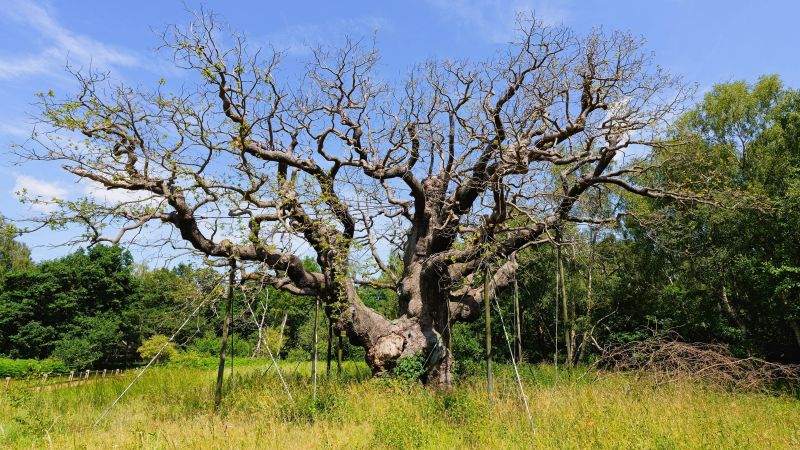
Ancient Sherwood Forest Oak Tree Reputed to Have Sheltered Robin Hood Has Died
Ancient Sherwood Forest oak tree reputed – In the heart of England’s Sherwood Forest, a tree that has long been intertwined with the tales of the legendary outlaw Robin Hood has met its end. This ancient oak, known as the Major Oak, has stood for over a millennium, symbolizing the forest’s storied past and the mythical figure who once hid within its towering canopy. British conservation group the Royal Society for the Protection of Birds (RSPB) confirmed the tree’s demise, citing its failure to produce new leaves this spring as a critical indicator of its decline. The news marks the end of an era for a tree that has become both a natural wonder and a cultural icon.
The Decline of the Iconic Tree
The Major Oak, estimated to be over 1,200 years old, was once among the largest in Britain, with a sprawling canopy measuring 28 meters (92 feet) in diameter and a trunk circumference of 11 meters (36 feet). For decades, it was protected with supports for its branches and surrounded by a fence installed in the 1970s to limit human interference. Despite these efforts, the tree’s health has steadily deteriorated, leading to its final decline. According to the RSPB, a combination of factors—primarily soil compression and the effects of prolonged hot, dry summers—has contributed to its death.
“While the Major Oak team worked tirelessly to revive the environment around this iconic tree—and saw encouraging signs of life in some areas—the damage, it now seems, was already too deeply entrenched to fully reverse,” said Simon Parfey, managing director of SoilBioLab, a soil microbiology firm involved in the tree’s care.
The tree’s condition has worsened over recent years, particularly during a series of record-breaking heatwaves. Reg Harris, director of arboriculture at Urban Forestry, noted that the most recent decline coincided with five consecutive summers of extreme drought. “The most notable of these was July 2022, when the UK recorded temperatures of 40 degrees Celsius,” he added. Such conditions, he explained, have placed immense stress on the tree, ultimately leading to its death.
Historical Roots of the Legend
Although the Major Oak is now gone, its association with Robin Hood remains deeply rooted in the forest’s history. Sherwood Forest, located near Nottingham, has traditionally been regarded as the outlaw’s hideout—a place where he evaded capture by the Sheriff of Nottingham and roamed the woods to steal from the wealthy and give to the poor. The tree’s reputation as a key location in the legend has drawn millions of visitors over the years, transforming it into a focal point of historical tourism.
“It has seen an enormous amount of activity,” said Chloe Ryder, the RSPB’s estate operations manager at Sherwood Forest. “The millions of visitors who have come to see it have inadvertently contributed to its decline.”
The connection between Robin Hood and the Major Oak, however, is not as ancient as its physical presence. While the tree has become a central figure in modern narratives about the outlaw, Alex Brown, an associate professor of history at Durham University, pointed out that early medieval accounts of the legend do not specifically mention the oak. “There are no explicit references to the tree in the earliest surviving stories of Robin Hood,” he explained in an email to CNN. “But the concept of distinctive meeting trees—called ‘trystle trees’—does appear in those texts, suggesting that a particular tree may have been symbolic from the beginning.”
Robin Hood’s story first emerged in the 14th century, evolving over centuries into a blend of folklore, literature, and popular culture. The Major Oak, though not directly named in the oldest accounts, has been widely adopted as the outlaw’s hideout, cementing its place in the national imagination. This association has endured through books, films, and TV shows, making the tree a living testament to the enduring power of myth.
Legacy and Future of the Forest
Despite its death, the Major Oak will continue to play a role in the history of Sherwood Forest. “The tree will remain at the heart of the forest as a natural monument for visitors to come and see,” said Hollie Drake, senior site manager at RSPB Sherwood Forest. “It lives on in the legend of Robin Hood and will continue to support the ecosystem in its absence.”
Conservationists have already taken steps to preserve the tree’s legacy. Acorns and cuttings from the Major Oak have been used to grow saplings, which have been planted in locations around the world, including in the US ambassador’s residence in London. These saplings, while not the same as the original tree, carry forward its genetic legacy, ensuring that its presence is not entirely erased.
Drake emphasized that the Major Oak’s death does not signal the end of its importance to the region. “With proper care, the tree could have remained standing for decades, even centuries,” she said. “Its removal is a loss, but the forest’s ecosystem and its cultural significance will endure.”
A New Chapter for Sherwood Forest
As the Major Oak lies dormant, Sherwood Forest faces the challenge of maintaining its historical allure while adapting to new environmental realities. The RSPB has since launched initiatives to rehabilitate the area, focusing on restoring the soil’s health and creating new habitats for the wildlife that once thrived around the tree. “The forest will continue to flourish, even in the absence of the Major Oak,” said Ryder. “Its story will not fade; it will simply be told in a different way.”
While the tree’s death is a poignant moment, it also presents an opportunity for reflection on the delicate balance between nature and human activity. The Major Oak’s fate highlights the impact of tourism and the challenges of preserving ancient landmarks in a modern world. As visitors continue to flock to Sherwood Forest, conservationists will work to ensure that the next generation can still experience the same sense of wonder and history that the tree once embodied.
For now, the Major Oak stands as a reminder of the enduring power of storytelling and the natural world’s ability to inspire. Its legacy will live on not only in the tales of Robin Hood but also in the efforts of those who seek to protect and preserve the stories that shape our understanding of history and nature alike.
