
Hobbit-like humans may have scavenged Komodo dragons’ leftovers to survive
Hobbit-like Humans May Have Scavenged Komodo Dragons’ Leftovers to Survive
Hobbit like humans may have scavenged – Recent research challenges long-held assumptions about the lifestyle of Homo floresiensis, the diminutive hominin species dubbed “hobbits” due to their small stature. This ancient group, which inhabited the Indonesian island of Flores between roughly 190,000 and 50,000 years ago, may have relied more on scavenging than on hunting large prey or using fire to cook food, according to a new study published in Science Advances. The findings suggest that these early humans were not as advanced as previously thought, with their brain size comparable to that of a chimpanzee. This challenges the idea that they possessed the cognitive abilities to hunt effectively or manipulate their environment with complex tools.
The Discovery on Flores Island
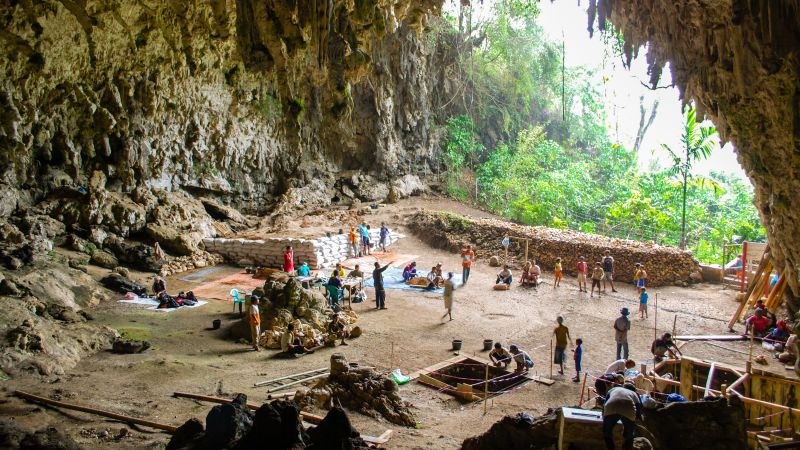
The fossils of Homo floresiensis were first uncovered in 2003 within the Liang Bua cave on Flores, sparking intense scientific interest. These remains, including a skull roughly the size of a grapefruit, indicated a species that stood about 3.3 feet tall—much smaller than modern humans. Alongside these bones, archaeologists found stone tools and remains of Stegodon florensis insularis, a massive herbivore related to elephants. The presence of these artifacts initially led experts to believe that the hobbits had hunted Stegodons using their tools to butcher the animals. Burned bones further fueled speculation that they could cook meat, a behavior typically associated with more advanced hominins.
However, new evidence from a multifaceted analysis of the Stegodon remains raises questions about these assumptions. Dr. Elizabeth Grace Veatch, a paleoanthropologist at the Smithsonian Institution’s National Museum of Natural History, led the study and sought to clarify the role of Homo floresiensis in their ecosystem. “I wanted to see if we really could show that H. floresiensis was the hunter that it had been portrayed as for decades,” she explained in an email. Her team’s investigation, which included a controlled experiment with Komodo dragons, revealed a different story.
Revealing Scavenging Behavior
To test the hypothesis, researchers brought in a living example of the island’s apex predator: the Komodo dragon. At Zoo Atlanta in Georgia, they observed a male Komodo named Rinca feeding on a goat carcass, analyzing the teeth marks left on the bones. This experiment provided a critical insight into how the lizards might have interacted with Stegodons. By comparing these marks to those made by stone tools, the team uncovered a pattern that supports the idea of scavenging over hunting.
The results were striking. Komodo dragon tooth marks were predominantly found on the most nutrient-rich portions of Stegodon bones, such as the meaty sections of the ribs and vertebrae. In contrast, the cut marks attributed to Homo floresiensis tools appeared on less desirable parts, like the joints or tendons. This suggests that the hobbits were not actively hunting the large herbivores but rather taking advantage of what the dragons left behind. The study also found no signs of fire-related modifications on the bones, implying that cooking may not have been a key part of their survival strategy.
The Evolutionary Implications
The discovery of thousands of stone tools near Homo floresiensis fossils has long been interpreted as evidence of their tool-making capabilities. However, this new research adds a layer of complexity to that interpretation. Coauthor Briana Pobiner, a paleoanthropologist at the Smithsonian Institution, noted that the tools were likely used for processing Stegodon remains, not for hunting them. “The tools were crafted to extract meat from bones, not to kill the animal outright,” she said. This aligns with the theory that the hobbits scavenged, rather than being active predators.
The findings also shed light on the relationship between Homo floresiensis and other hominins. While some researchers had previously speculated that the species was closely tied to Homo erectus, this study implies a more distinct evolutionary path. The Komodo dragon’s role as a scavenger appears central to the hobbits’ survival, with the lizards possibly providing a steady food source. Veatch’s analysis of the bones revealed that the hobbits may have used their tools to strip flesh from the carcasses, a process that required less physical exertion than hunting large prey.
Comparing Ancient and Modern Behaviors
Komodo dragons are known for their powerful bite and venomous saliva, which can incapacitate large animals like water buffalo. The researchers hypothesize that the hobbits capitalized on this natural behavior, waiting for the lizards to kill their prey and then scavenging the leftovers. This strategy would have minimized the need for complex hunting techniques or the use of fire to prepare food. The study’s comparison of tooth marks and cut marks highlights the significance of these observations, as the similarities between the two suggest a shared use of tools and teeth for meat processing.
Veatch emphasized the importance of this discovery in redefining the hobbits’ place in human evolution. “The marks on the Stegodon bones were more consistent with scavenging than hunting,” she wrote. The absence of burned bones further supports this theory, as cooking requires fire control—a skill often linked to advanced cognitive abilities. While Homo erectus and other large-brained hominins are typically associated with fire use, the new research implies that Homo floresiensis may have prioritized efficiency over complexity in their survival tactics.
A New Perspective on the Family Tree
The implications of this research extend beyond the immediate findings. By demonstrating that Homo floresiensis likely scavenged rather than hunted, the study challenges the traditional narrative of human evolution. It raises questions about the cognitive and physical capabilities of this species, suggesting that their survival strategies may have been simpler than previously assumed. The discovery also highlights the importance of understanding how ancient hominins interacted with their environment, particularly with predators like the Komodo dragon.
Stegodon, which weighed about 1,260 pounds and stood nearly 5 feet tall at the shoulder, was a dominant herbivore on Flores. Its remains, combined with those of the hobbits, indicate a dynamic ecosystem where the two species coexisted. The idea that Homo floresiensis relied on scavenging rather than hunting could explain their smaller brain size and physical stature. It also underscores the adaptability of early humans, who may have evolved to thrive in resource-limited environments by exploiting the leftovers of larger animals.
This research adds to a growing body of evidence that Homo floresiensis was not as advanced as once believed. While they may have used tools, their reliance on scavenging suggests a more opportunistic approach to survival. The study’s use of 3D scanning to analyze bone markings demonstrates how modern technology can refine our understanding of ancient behaviors. By bridging the gap between fossil records and living examples, the team has provided a clearer picture of how these hobbit-like humans navigated their isolated world.
Expert Reactions and Future Research
Experts in the field are now reconsidering the place of Homo floresiensis in the broader context of human evolution. The species, which thrived on Flores for tens of thousands of years, may have developed specialized techniques for extracting meat from bones, much like modern-day scavengers. Veatch’s work, which combined experimental observations with archaeological data, offers a compelling case for this revised interpretation. “The evidence points to a more passive role in the food chain,” she said in a recent interview. “They weren’t the primary hunters, but they were highly efficient scavengers.”
As the debate continues, further research into the ecological interactions between Homo floresiensis and Komodo dragons could unlock more insights. The study’s findings also highlight the importance of interdisciplinary approaches in paleoanthropology, blending biology, archaeology, and technology to paint a more accurate picture of the past. While the hobbits may have lacked the cognitive traits of larger-brained hominins, their survival strategies demonstrate a unique form of adaptation to their environment. This research not only reshapes our understanding of Homo floresiensis but also reminds us that intelligence and survival can take many forms, even in the most unexpected species.
