
Look of the Week: Michelle Obama honors her late mother in a custom-made skirt
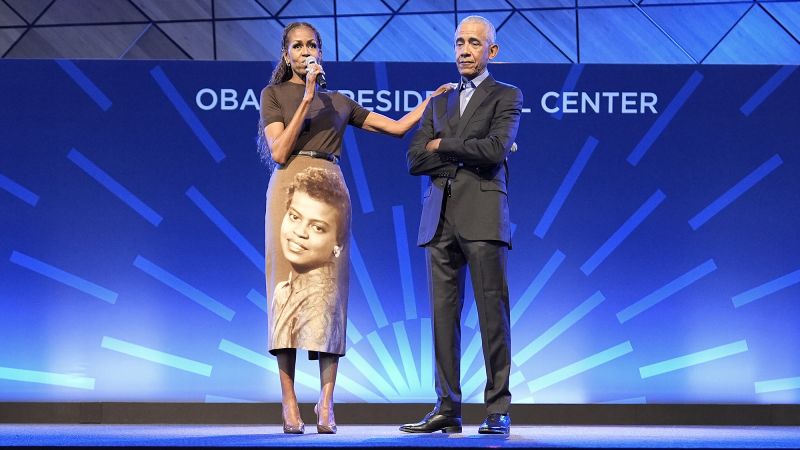
Mother’s Memory Wears a New Garb: Michelle Obama’s Tribute at the Obama Presidential Center
A Fashion Statement Rooted in Memory
Look of the Week – Michelle Obama’s recent appearance at the Obama Presidential Center in Chicago sparked immediate attention, not for the event itself, but for the poignant outfit she chose to wear. The former first lady opted for a sleek pencil skirt adorned with a striking portrait of her late mother, Marian Robinson, a design that seamlessly blended personal sentiment with public symbolism. This choice, made in collaboration with her longtime stylist Meredith Koop, underscored a recurring theme in Obama’s fashion narrative: the ability to turn attire into a vehicle for storytelling.
The Artistry Behind the Skirt
The custom-made skirt, crafted by Acne Studios, was more than a fashion piece—it was a tribute. Its sepia-toned palette evoked nostalgia, while the central image of Robinson, captured in a cherished photograph, offered a tactile connection to her legacy. Koop had previously worked with the brand, and the design echoed a runway look from Acne’s Fall-Winter 2026 collection, which featured a similar silhouette with a portrait of a young man by Dutch artist Paul Kooiker. The styling, however, was distinctly Obama: a minimalist belt, a chocolate brown T-shirt, and slingback pumps, mirroring the look of a Parisian model from the same collection.
For decades, Obama has wielded fashion as a tool to communicate deeper meanings. Her 2008 inauguration, for instance, was a defining moment where she defied convention by selecting a design from Jason Wu, a relatively unknown Taiwanese Canadian creator. “Big name designers tended to dress the first lady for inauguration,” Obama recounted in a later interview with Vogue, “but I was pretty clear I wanted to change that up.” Wu’s work, steeped in immigrant resilience, resonated with the couple’s own journey, symbolizing a fresh start for the nation.
A Diplomatic Language of Style
During Barack Obama’s presidency, Michelle’s wardrobe became a subtle yet powerful form of political expression. One standout moment was the 2016 state dinner honoring Italy’s Prime Minister Matteo Renzi and his wife, Agnese Landini. She wore a Versace gown of rose gold chainmail, a bold statement that balanced elegance with a nod to Italian heritage. The shimmering design served as both a tribute to the guests and a shield for a leader navigating turbulent times, its opulence reflecting the gravity of the occasion.
Post-White House, Obama’s style evolved, embracing more avant-garde silhouettes. Her 2018 book tour, *Becoming*, showcased this shift, with one particular outfit—bright yellow Balenciaga wrap dress paired with sequined thigh-high boots—capturing the essence of her new chapter. The vibrant colors and daring accessories signaled a departure from the traditional, conservative first lady image, offering a visual metaphor for her continued influence beyond the political sphere.
A Surprise in the Spotlight
On Tuesday’s stage, Obama’s choice of attire carried an unexpected twist. She revealed that her husband, Barack, had been unaware of the skirt’s design until moments before the event. “He’s really messed up,” she shared with the audience, her voice cracking with emotion. “I’m giving him some time because this beautiful skirt that my stylist Meredith Koop picked out—this is my favorite portrait of my mom—he didn’t know it existed until just a few minutes ago.” The revelation left the crowd moved, highlighting a universal yearning to share life’s milestones with those who shaped our past.
The skirt’s emotional resonance was amplified by the context of the event. As the Obama Center unveiled its *Opening the White House* exhibit, named in honor of Robinson, the former first lady’s presence felt like a deliberate act of homage. “I am a little shaken up by this because I loved my mother-in-law,” Barack Obama remarked, reflecting on the significance of the moment. “She made a home for Michelle and Craig,” he added, referring to his brother-in-law, “not with a lot, but with a lot of love, hope, and perspective. They represent, to me, what’s best about this country.”
The Power of Sartorial Subtlety
Obama’s ability to merge personal history with public symbolism has long been a hallmark of her style. Whether it’s a single garment or an entire ensemble, her choices often carry layers of meaning. The mother-themed skirt, for example, was a quiet yet profound gesture, one that required both emotional depth and strategic design. It reminded viewers of how clothing can bridge the gap between private memory and collective identity, transforming the ordinary into the extraordinary.
This approach aligns with her broader legacy as a fashion ambassador who championed emerging talent. By spotlighting designers like Wu and Acne Studios, she not only elevated their profiles but also signaled her commitment to diversity and innovation. Her 2026 look, while rooted in tradition, also hinted at a forward-thinking vision, proving that even in moments of reflection, she remains a trailblazer.
As the Obama Center’s exhibit continues to honor Robinson, the former first lady’s Tuesday appearance serves as a reminder of the enduring power of style. Her choices, both on and off the political stage, have consistently transcended aesthetics, becoming a dialogue between personal expression and public narrative. The sepia-toned skirt, with its intimate portrait, encapsulates this duality—celebrating a cherished memory while ensuring it remains part of the national conversation. In a world where fashion often speaks louder than words, Michelle Obama’s latest look is a testament to the enduring strength of her sartorial storytelling.
“The art of fashion diplomacy lies in making the invisible visible,” Obama once said, reflecting on her role as a style icon. “It’s about weaving personal history into the fabric of our shared experiences.” This philosophy is evident in every stitch of her wardrobe, from the modest beginnings of her 2008 inaugural gown to the audacious choices that followed. Her 2026 appearance, with its blend of elegance and emotion, reaffirms that fashion remains a vital language in both private and public life.
As the Obama Center’s legacy grows, so too does the recognition of figures like Marian Robinson, whose influence extends far beyond her passing. Through Michelle Obama’s fashion choices, the late mother’s presence is immortalized, a reminder that even in the absence of physical companionship, her spirit lingers in the details we choose to celebrate. The skirt, with its carefully curated design and heartfelt message, is more than an outfit—it’s a legacy in fabric, a symbol of love, and a lasting tribute to the woman who shaped an icon.
