
Beloved British artist David Hockney dies at 88
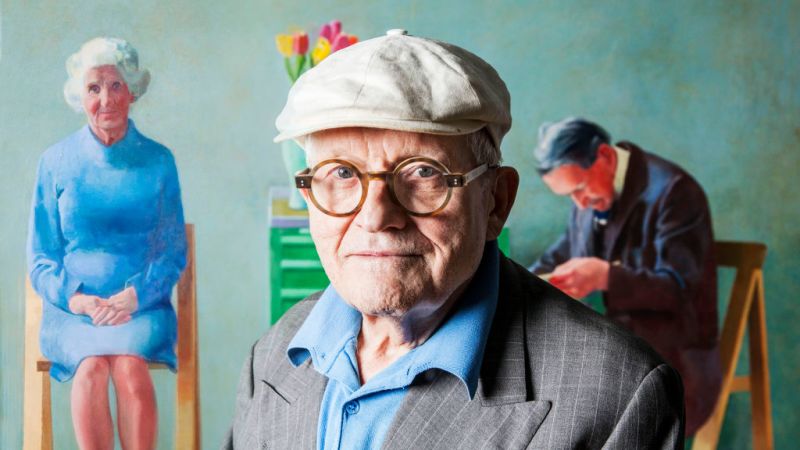
Beloved British artist David Hockney dies at 88
Beloved British artist David Hockney dies – David Hockney, the celebrated British painter known for his bold color palettes and dynamic portrayals of everyday life, has passed away at the age of 88. His death occurred “peacefully at home” on Thursday, just one month before his 89th birthday, as confirmed by his publicist, Erica Bolton, who shared the news with CNN. Hockney’s work, spanning decades, left an indelible mark on contemporary art, blending personal expression with innovative techniques.
Early Life and Career
Born in 1937 in Bradford, England, Hockney’s artistic journey began in his local art school before he pursued further studies at the Royal College of Art in London. His early success was notable, earning him recognition even as a young artist. By the 1960s, he had relocated to Los Angeles, a move that would shape much of his creative output. Though he taught at various American institutions, his work quickly became a cornerstone of the Pop Art movement, characterized by its playful use of color and bold, often whimsical, compositions.
Unlike his contemporaries such as Andy Warhol, who focused on mass production and consumer culture, Hockney remained deeply rooted in the tangible world around him. His art often captured the intimacy of domestic scenes, from the quiet interactions of friends to the sunlit clarity of a swimming pool. This personal touch became a hallmark of his style, which was both meticulous and expressive. His early works, like the iconic “Portrait of an Artist (Pool with Two Figures),” showcased his ability to transform ordinary moments into timeless masterpieces.
Exploring Themes of Identity and Intimacy
Hockney’s exploration of identity extended beyond visual art into the realm of sexuality. In his youth, when homosexuality was still criminalized in England, he used his work to celebrate queer relationships through vivid, sometimes explicit imagery. His self-portraits and still-life pieces often depicted men engaged in intimate settings—showering together or sharing quiet conversations—rendering the familiar with an almost surreal sense of immediacy. These works, though rooted in personal experience, resonated widely, offering viewers a fresh perspective on everyday life.
Among his most renowned series are the swimming pool paintings, which appeared to freeze time in their luminous, almost cinematic quality. These pieces, created in the 1970s and 1980s, were not only visually striking but also narrative in nature, suggesting stories through their compositions. Hockney’s ability to blend reality with imagination made his art accessible yet profound. His later works, which embraced abstraction and new media, reflected his evolving creative vision, from photomontages to digital renderings.
Commercial Success and Personal Philosophy
Despite his widespread acclaim, Hockney never seemed overly preoccupied with commercial success. This was evident when his record-breaking painting, “Portrait of an Artist (Pool with Two Figures),” sold for $90.3 million in 2018, setting a new auction record for living artists. Yet, the piece had originally been purchased for just $18,000 in 1972 by his New York dealer. This disparity underscored Hockney’s belief that art should transcend market value, rooted instead in emotional and aesthetic resonance.
Even as his work fetched millions, Hockney remained committed to his creative process. During a 2017 visit to his California studio, the then-80-year-old artist described his daily routine with infectious enthusiasm. “I’m perfectly happy doing this,” he remarked, “I feel 30 when I’m in the studio, so I come in every day and work, because then I feel 30.” This sentiment reflected his philosophy: art was not just a profession but a lifeline. His dedication to painting was unwavering, even as he embraced new technologies like the iPad, which he used during the pandemic to create digital landscapes.
Hockney’s adaptability was a defining trait. During the height of the pandemic, he spent time in Normandy, France, producing digital sketches of the countryside. These works were later printed and displayed at prestigious venues, including London’s Royal Academy and the de Young Museum in San Francisco. His ability to merge traditional techniques with digital innovation demonstrated a lifelong curiosity about the evolving nature of artistic creation.
Legacy and Recognitions
Throughout his career, Hockney was celebrated for his inventive spirit and ability to challenge conventions. A statement from Tate Britain’s director, Alex Farquharson, highlighted his contributions: “He was an endlessly inventive artist who taught us about the joy of looking, seeing things the rest of us failed to notice—his witty and sharp observations a constant presence in his work and in person.” This praise encapsulated the essence of his legacy, which extended far beyond the canvas.
Hockney’s accolades were numerous, including membership in the Royal Academy of Arts and prestigious awards such as the John Moores Painting Prize and the Japan Art Association’s Praemium Imperiale prize. Notably, he declined a knighthood, preferring to remain a “commoner” in the eyes of the public. However, in 2012, he accepted an invitation to join the Order of Merit, a distinguished group of individuals recognized for their exceptional achievements.
His influence on the art world was profound, with retrospectives held at major institutions like Tate Britain, the Pompidou Centre in Paris, and the Metropolitan Museum of Art in New York. These exhibitions showcased the breadth of his work, from photography and printmaking to stage designs for ballet and opera. Hockney’s versatility and passion for experimentation ensured that his artistic journey remained as dynamic as his early days. As his career progressed, he continued to push boundaries, proving that creativity knows no bounds, regardless of age or medium.
Even in his later years, Hockney’s work remained vibrant and relevant. His ability to capture the essence of a moment, whether through a still-life or a digital landscape, spoke to a lifetime of artistic exploration. The British artist’s final years were marked by a deep connection to his craft, and his contributions to the visual arts will continue to inspire for generations to come. With his signature mop of blond or gray hair, large glasses, and frequent cigarette, Hockney became a recognizable figure, embodying the spirit of innovation and authenticity that defined his career.
