
Tricycle ambulances are saving lives in Ghana
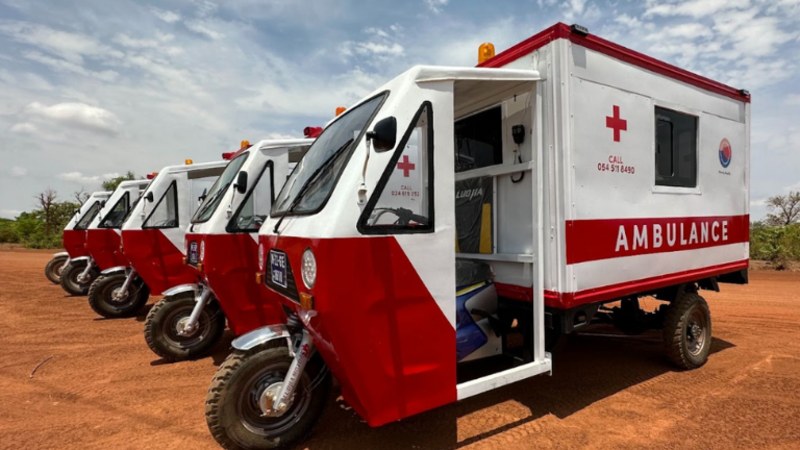
Tricycle Ambulances are Saving Lives in Ghana
Tricycle ambulances are saving lives in Ghana – In the remote villages of Northern Ghana, where access to healthcare is often limited by distance and unreliable infrastructure, a simple yet innovative solution has emerged. The tricycle ambulance, a vehicle designed by the nonprofit Moving Health, is revolutionizing emergency care by bridging critical gaps in transportation. These compact, motorized units are not only transforming the way patients are moved but also significantly improving maternal health outcomes in some of the country’s most underserved regions.
A Life-Saving Innovation
For Billeh Rosemount, a 24-year-old farmer from a rural community in the Upper West Region, the tricycle ambulance was a lifeline during a medical emergency. In October 2024, she experienced a miscarriage and was bleeding heavily, with the midwife at her local clinic unable to stem the flow. Without immediate access to a conventional ambulance, which could take hours to arrive in such an isolated area, Rosemount’s fate hung in the balance. Her rescue came in the form of a modified tricycle ambulance, which swiftly transported her to a larger facility. “I had to beg for someone to help,” she recalled. “It was very, very difficult for us.”
“You have to go and beg for somebody to get the vehicle… It was very, very, very difficult for us,” Rosemount said, emphasizing the struggle of rural communities to secure transport during emergencies.
These vehicles, built with a motorcycle engine, are engineered to tackle the region’s challenging terrain. Unlike traditional ambulances, which can get stuck on narrow, dirt roads, tricycle ambulances are agile and efficient. They are equipped with a full-length stretcher, room for a family member or community health worker, basic life support systems, an oxygen concentrator, and emergency birthing kits. This design ensures that critical care is available even before reaching the hospital, making the journey itself less perilous.
The Broader Context of Maternal Mortality
Maternal mortality in Ghana, while steadily declining, remains a pressing issue. According to 2023 statistics, the country recorded 234 maternal deaths per 100,000 live births, a figure lower than the regional average but still 14 times higher than in the United States. The World Health Organization reports that Sub-Saharan Africa accounts for approximately 70% of global maternal deaths, with rural areas being particularly vulnerable. Distance, poverty, and unreliable transport systems contribute to delays in care, often leading to preventable tragedies.
Many women in these regions face the risk of childbirth without medical assistance. “Due to that, you have to just sit in the house and give birth… you can lose one of the lives, the mother or the child,” Rosemount explained. Her experience highlights the urgent need for accessible, rapid transportation to healthcare centers. Moving Health’s tricycle ambulances address this by ensuring that emergency care is not only reachable but also equipped to handle the unique needs of rural populations.
From MIT to Rural Ghana
The concept of the tricycle ambulance originated at the Massachusetts Institute of Technology in 2016. A group of mechanical engineering students, including Emily Young, the CEO and co-founder of Moving Health, developed the idea as part of a design project. The goal was to create a cost-effective solution for regions where traditional ambulances were too expensive or impractical to operate. By 2019, the initiative had transitioned from a student experiment to a full-scale program in Ghana, with operations now rooted in the Upper West Region.
Young and her team recognized the importance of adapting medical transport to local conditions. “Sometimes the biggest barrier to surviving a medical emergency isn’t the lack of hospitals,” Young said. “It’s being able to get there in time.” This insight drove the development of the tricycle ambulances, which are manufactured locally and cost only one-tenth of conventional vehicles. The affordability allows communities to sustain the program, while the design ensures functionality in tough environments.
Scaling the Impact
Since its launch, Moving Health has expanded its reach across five districts, providing emergency transport for over 230,000 people in rural areas not served by the National Ambulance Service. The organization has deployed 31 tricycle ambulances, which are stationed at community clinics and can be reached via a dedicated hotline or by bike messengers when needed. This proximity is vital in regions where mobile networks are inconsistent, ensuring that help arrives promptly even in remote locations.
According to a 2024 study, Ghana’s National Ambulance Service has grown from just 55 vehicles in 2020 to 356 in 2024, covering a population of around 35 million. However, these services still face challenges in reaching the most isolated communities. Moving Health’s tricycle ambulances fill this gap, transporting patients up to 100 kilometers to regional or national hospitals for advanced care. The organization reports a 64% reduction in transport time, a critical factor in saving lives during emergencies.
Personal Stories Behind the Mission
Isaac Quansah, who serves as Moving Health’s chief technology officer and country director, has a deeply personal connection to the program. After his wife gave birth to their first child, postnatal complications left her immobile, and the couple struggled to find an ambulance. “I drove her to the hospital in a small car, which required her to sit up in excruciating pain,” Quansah shared. “When I design an ambulance, I know that I have a reason.”
“A life-fulfilling purpose for me to help other mothers not go through what my wife went through,” Quansah told CNN, underscoring the emotional drive behind the project.
Quansah oversees local manufacturing in Ghana, where the nonprofit employs and trains engineers to maintain and upgrade the vehicles annually based on community feedback. This iterative process ensures that the ambulances meet evolving needs. For instance, health workers noted that women often give birth during their journey to the hospital, sometimes at night. “Can you imagine trying to (deliver a baby,” Quansah added, reflecting on the design’s adaptability to such scenarios.
The success of Moving Health’s initiative is a testament to the power of innovation tailored to local challenges. By combining engineering expertise with community-driven solutions, the organization has created a model that not only saves lives but also empowers rural populations. As Ghana continues to invest in its healthcare infrastructure, the tricycle ambulance stands as a symbol of progress, proving that even in the most difficult conditions, timely care can make all the difference.
