
Egypt uncovers lost Byzantine-era city in the western desert
Egypt Uncovers Lost Byzantine-Era City in the Western Desert
Egypt uncovers lost Byzantine era city – Following a major archaeological revelation, Egypt announced two significant discoveries on Saturday that highlight the country’s rich historical heritage. Among them, a remarkably well-preserved residential city from the Byzantine era in the western desert has drawn particular attention, offering new insights into the region’s ancient past. This find, alongside another in the Marina el-Alamein site near Alexandria, underscores Egypt’s efforts to revitalize its tourism industry through cultural relics and historical sites.
Dakhla Oasis: A Window into Daily Life
The Dakhla Oasis, situated in the New Valley region of Egypt’s western desert, has revealed a residential city that dates back to the fourth century. According to the Tourism and Antiquities Ministry, the site provides a detailed glimpse into the urban layout and societal structure of the time, when Egypt was under Byzantine rule. The city’s architecture includes north-south streets crossed by east-west avenues, creating open squares and communal areas, as noted by Hisham el-Leithy, the secretary general of the supreme council of antiquities.
“The quarters uncovered display a sophisticated understanding of urban planning, with thoroughfares and public spaces suggesting organized civic life,” said el-Leithy.
Among the most notable structures is a basilica church, believed to have been built in the mid-fourth century. This church, positioned at the city’s center, overlooks its main streets, while remnants of two watchtowers were found near the perimeter, likely serving to protect the settlement from external threats. Mahmoud Massoud, head of the archaeological mission, described the site as a treasure trove of Byzantine-era artifacts.
Archaeologists also uncovered a variety of domestic structures, including a heavily fortified building with thick defensive walls. These walls, combined with the presence of reception halls and vaulted rooftops, indicate the city’s strategic importance. One particularly significant find is the “house of Tisous,” a residence linked to a church deacon. This structure is thought to have functioned as a house church before the basilica was constructed.
“The house of Tisous provides evidence of early Christian presence in the region, highlighting the religious and economic activities of the time,” Massoud explained.
Additional artifacts, such as bread ovens, kitchens, and stone grinding tools, suggest the city’s role in daily sustenance. These items, along with bronze coins featuring Byzantine emperor portraits and Christian symbols, offer a tangible link to the era. Latin inscriptions found at the site further enrich the historical narrative, detailing commercial transactions and personal correspondence.
Marina el-Alamein: Tombs and Rituals
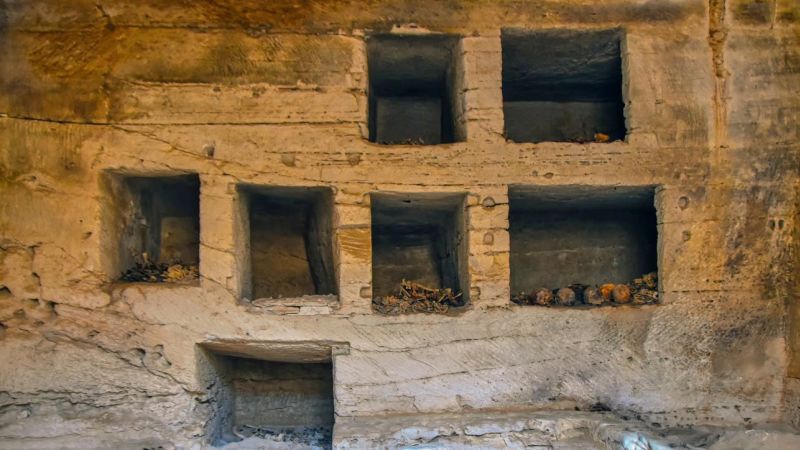
At the Marina el-Alamein site, approximately 100 kilometers west of Alexandria, archaeologists uncovered 18 ancient tombs, bringing the total discovered there to 48. The tombs include 11 rock-cut structures averaging 8 meters in depth and seven surface-built limestone tombs, as stated by the ministry. These findings are not only significant for understanding burial practices but also for shedding light on the area’s historical context.
Within the site, researchers recovered pottery vessels, amphorae, lamps, and altars, which reflect the cultural and religious practices of the time. A particularly striking artifact is a 2.5-meter-long granite sarcophagus found near the tombs. Eman Abdel-Khaliq, the mission’s chief, shared that skeleton remains inside the sarcophagus are currently under study, providing clues about the lives and deaths of those who lived there.
“Near the sarcophagus, we also discovered the remains of a plaster sphinx statue, which may have held symbolic or decorative significance,” Abdel-Khaliq added.
One of the most intriguing discoveries is the “golden tongue” practice, where four gold pieces were found placed in the mouths of some deceased individuals. This tradition, associated with Byzantine funerary beliefs, suggests a belief in the afterlife and the importance of sustenance for the soul. The site, which has been under excavation since 1986, is believed to be the ancient Greco-Roman port city of Leukaspis, active until the fourth century.
Reviving Tourism Through Antiquities
Egypt’s tourism sector has been working to rebound after years of political instability and the impact of the coronavirus pandemic. The Ministry of Tourism and Antiquities has emphasized that these discoveries are part of a broader strategy to attract visitors to the country’s cultural landmarks. As a key component of Egypt’s economy, tourism has seen a steady recovery, with 19 million tourists recorded last year—a 21% rise compared to the previous year.
The first four months of 2026 marked a 4% increase in visitor numbers, with 6.1 million tourists arriving compared to 5.7 million in the same period of 2025. These figures highlight the growing interest in Egypt’s historical sites, including the Dakhla Oasis and Marina el-Alamein, which are now being re-evaluated for their potential to draw international attention. The Dakhla Oasis, already on UNESCO’s Tentative List, is poised to become a World Heritage Site, further boosting its appeal as a destination.
Meanwhile, the Marina el-Alamein site continues to yield discoveries that connect modern visitors to the past. Its proximity to Alexandria, a major Mediterranean city, also makes it a strategic location for cultural tourism. As archaeologists delve deeper into these sites, the significance of their findings becomes clearer, reinforcing Egypt’s position as a cradle of ancient civilizations.
The recent excavations at both locations are part of a larger initiative to highlight Egypt’s archaeological wealth. With over 48 tombs identified in Marina el-Alamein and the residential city in Dakhla, these sites are not only preserving history but also reviving economic activity. The Ministry’s efforts to showcase these discoveries align with global trends in heritage tourism, where the allure of ancient artifacts drives interest and investment.
These findings are a testament to the enduring legacy of the Byzantine era in Egypt. From the well-organized urban centers to the sacred burial sites, each artifact and structure tells a story of resilience and cultural exchange. As the country continues to uncover its past, the balance between preservation and tourism becomes increasingly vital, ensuring that Egypt’s ancient wonders remain accessible for future generations.
