
National Mall prayer event sparks concern about Trump administration eroding the wall between church and state
National Mall prayer event sparks concern about Trump administration eroding the wall between church and state
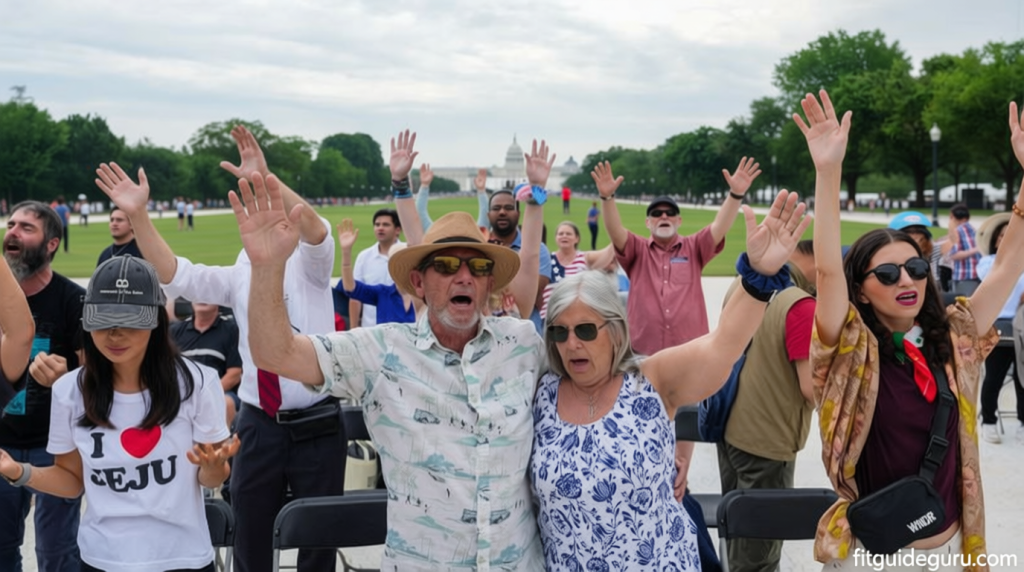
National Mall prayer event sparks concern – On Sunday, a full-day prayer gathering held on the National Mall became a focal point in the ongoing debate about the Trump administration’s influence on the separation of church and state. The event, titled “Rededicate 250: A National Jubilee of Prayer, Praise & Thanksgiving,” was organized as part of a series of commemorations for America’s 250th anniversary. It received backing from the White House, which combined public funds with private contributions to support its activities. Faith leaders, government officials, and musicians converged at the site, creating a vibrant atmosphere that blended religious reflection with patriotic celebration.
The National Mall, traditionally a secular space for public events, saw a striking shift as attendees filled the area despite the heat. The event’s stage was a visual spectacle, featuring towering white columns and stained-glass windows that depicted the Founding Fathers. This symbolic design aimed to evoke historical imagery while reinforcing the nation’s religious roots. President Donald Trump, through a video message, briefly referenced the Bible’s Book of Chronicles, setting the tone for a day that combined spiritual reverence with political messaging. House Speaker Mike Johnson followed with a prayer, urging attendees to embrace “piety and patriotism” as core values for the United States.
A blend of tradition and political agenda
While the event invited Americans of diverse backgrounds, the list of participants leaned heavily toward evangelical Christians. Only one Orthodox rabbi and two conservative Catholic bishops were among the faith leaders present, highlighting a predominantly Christian focus. This dynamic was underscored by the White House’s involvement, with senior policy adviser Brittany Baldwin noting the administration’s intent to “celebrate our heritage as a Judeo-Christian” nation. Her remarks came from a planning webinar that was later removed, suggesting a strategic effort to frame the event within a specific religious narrative.
Freedom 250, the nonprofit organization behind the event, described its purpose as a moment to “reflect on where we have been, recommit ourselves to the ideals that define us, and look toward the future with renewed hope and purpose.” The group, functioning as the National Park Service’s fundraising arm, sought to merge historical commemoration with spiritual engagement. Yet, critics argue that the administration’s backing of the event blurs the line between religious expression and government endorsement, raising questions about the constitutional implications of such actions.
Among the attendees was Vicky Kanaga, who traveled from Massachusetts to participate in what she called an opportunity to “turn our country back to God.” She expressed hope that the event would reinvigorate a sense of moral direction in American society. Similarly, Ryan Phillips, a participant from Mississippi, emphasized that the event’s purpose was to honor the nation’s traditions. “The concept of separation means the government should not enter the church, nor should the church enter the government,” he said, framing the event as a celebration of shared values rather than a challenge to constitutional principles.
Constitutional debates intensify
“This kind of divisive embrace of a particular religion and trying to associate the incumbent administration with that religion is bad for religion, bad for government and bad for America,”
said Andrew Koppelman, a constitutional law professor at Northwestern University. He acknowledged the event’s legality since no court had issued an injunction against it, but he argued that it diverged from the Constitution’s foundational goals. Koppelman viewed the administration’s actions as a subtle yet significant effort to promote a specific religious identity within the public sphere.
“It is unconstitutional because it is explicit government promotion of religion, and not just religion in general, but of a fairly specific version of one particular religion,”
asserted Douglas Laycock, a law professor specializing in religion and constitutional matters at the University of Texas. Laycock’s critique emphasized the event’s role in advancing a narrow Christian perspective, potentially undermining the principle of religious pluralism. His argument aligns with concerns that the administration’s policies increasingly prioritize one faith over others.
Michael Moreland, a law professor at Villanova’s Charles Widger School of Law, offered a contrasting viewpoint. He argued that the intersection of religious faith and public life is inherent in American traditions, citing examples such as congressional prayers and the inauguration ceremony. “It’s too strong a separationist view of what the First Amendment requires,” Moreland stated, suggesting that the event’s activities fall within the bounds of acceptable religious expression.
Political defense and broader implications
Johnson, a devout Christian, defended the event during a Fox News interview on the National Mall. He framed the gathering as a natural recognition of the country’s “religious and moral tradition,” emphasizing its role in celebrating shared national identity. White House spokeswoman Taylor Rogers added that the event would “highlight the values that unite us as a nation.” However, these statements have been interpreted as attempts to justify the administration’s alignment with specific religious groups.
Despite the administration’s efforts to present the event as a unifying celebration, the focus on Christianity has drawn criticism from those who fear its impact on religious freedom. The Trump era has seen a pattern of faith-based initiatives that critics argue prioritize Christian values in government operations, culture, and policy. From the appointment of religious figures to key roles in the executive branch to the promotion of religious observances at public events, these actions have fueled debates about the balance between religious expression and secular governance.
As the nation marks its 250th anniversary, the Rededicate 250 event has become emblematic of a broader trend. The administration’s consistent support for religiously themed activities suggests a deliberate effort to shape public discourse in favor of a particular faith. While some see these gestures as a reflection of American heritage, others view them as a challenge to the constitutional framework that ensures equal treatment of all religions. The National Mall, historically a symbol of democratic ideals, now serves as a stage for this ideological clash, with the event’s outcome likely to influence future discussions on the role of religion in public life.
