
Peter Thiel in Aspen: The pope is ‘working for the Chinese Communists’
Tech Billionaire Peter Thiel Accuses Pope of Chinese Alignment in AI Remarks
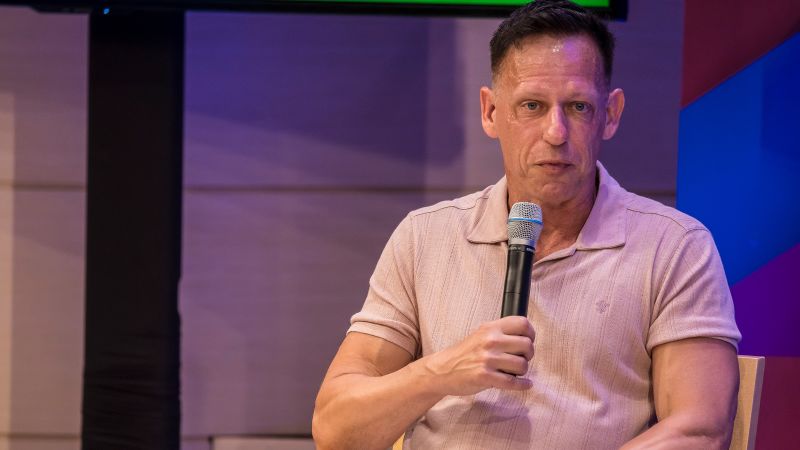
Peter Thiel in Aspen – At the Aspen Ideas Festival in Colorado, Peter Thiel, a prominent tech investor and co-founder of PayPal and Palantir, delivered a series of bold critiques about the trajectory of artificial intelligence and its implications for global power dynamics. During the event, he took a sharp turn toward religious and political commentary, leveling a surprising accusation against Pope Leo XIV: that the pontiff is effectively acting as a “Chinese communist agent” by advocating for stricter AI regulation. This claim, which drew mixed reactions from the audience, followed a broader discussion on how Western democracies are being outpaced in the race to develop advanced technologies.
Thiel, a longtime backer of Donald Trump’s presidential campaign, argued that the pope’s recent encyclical, Magnifica Humanitas (“Magnificent Humanity”), risks slowing the United States’ progress in AI innovation. In May, the Pope called for international oversight of artificial intelligence, emphasizing the need to “disarm” the technology to prevent existential risks. Thiel contended that this message, while influential among American Catholics, would not resonate with China, where AI development remains a top priority. By pushing for regulations that favor global cooperation, he claimed, the Pope is indirectly supporting Chinese interests at the expense of U.S. competitiveness.
Thiel’s remarks were delivered alongside political theorist Francis Fukuyama in a panel titled “Humanity at the End of History.” The discussion marked a departure from their previous debates, which focused on economic challenges such as income inequality and the stagnation of clean energy technologies. This time, the conversation turned to the future of Western democracy, with Thiel framing it as a battleground between competing ideologies. He warned that the Democratic Party is under threat from a “democratic-socialist takeover,” a scenario he believes could destabilize the nation’s political landscape.
“I think there’s going to be a democratic-socialist takeover of the Democratic Party,” Thiel asserted. “When the Democratic Party goes, this country is over.”
His argument hinges on the growing influence of self-identified democratic socialists within the party. Last year, New York City Mayor Zohran Mamdani, a vocal advocate for socialist policies, was elected as a prominent figure in the Democratic fold. This year, democratic socialist candidates have achieved notable victories in local and congressional primaries, signaling a shift in the party’s direction. Thiel, who has long criticized the Democratic Party’s embrace of progressive policies, viewed these developments as evidence of a broader ideological transformation.
Thiel’s relationship with the Vatican has been contentious for years. In March, he hosted an exclusive lecture series in Rome, just a few blocks from the Holy See, exploring the concept of the Antichrist. The talks, which drew criticism from some Catholic institutions, suggested that Thiel sees a world government as the next stage of political evolution. He proposed that this entity, led by elites, could emerge as a solution to challenges like AI and climate change, effectively replacing traditional democratic structures.
During the Aspen panel, Thiel’s critique of institutions extended to the Democratic Party. “The weird ways that politics has gone haywire is telling me something very deep,” he said, highlighting the disconnect between policy and progress. He argued that democratic institutions have become sources of paralysis, unable to adapt to the rapid changes driven by technological advancements. This perspective contrasts with Fukuyama’s, who previously championed the idea that liberal democracy represents the “end of history” after the Cold War.
Fukuyama, renowned for his “End of History” thesis, emphasized the resilience of democratic systems despite growing extremism. In the current debate, he warned that abandoning key democratic institutions could jeopardize the stability of Western societies. Thiel, however, countered that these institutions are no longer serving their purpose, instead creating gridlock and stifling innovation. His critique of the Democratic Party’s institutional framework aligns with his broader skepticism of technocratic governance, which he has championed in the past.
Thiel’s political views have sparked debate among scholars. Critics label his stance as “techno-authoritarianism,” arguing that his distrust of democratic institutions and support for elite-led governance could lead to centralized control. This line of thinking echoes his earlier work, including his role in launching JD Vance’s political career. Vance, who once worked at Mithril Capital, an investment firm Thiel co-founded, now represents a key figure in the Republican Party, a contrast to Thiel’s current focus on the Democratic Party’s transformation.
While the Vatican has not publicly responded to Thiel’s accusations, the remarks reflect a pattern of friction between the tech billionaire and the Catholic Church. His March lecture series on the Antichrist, hosted in Rome, reportedly unsettled Vatican officials, prompting two Catholic universities to distance themselves from the event. Thiel’s vision of a future dominated by a world government seeking to protect humanity from existential threats underscores his belief in the necessity of strong, centralized leadership in an age of rapid technological change.
As the Aspen Ideas Festival concluded, Thiel’s comments left the audience divided. Some found his portrayal of the Pope as a “Chinese communist agent” provocative, while others saw it as a sharp critique of global power shifts. His remarks also highlighted the growing ideological divide within U.S. politics, where the Democratic Party is increasingly seen as a target for progressive realignment. With the 250th anniversary of the Declaration of Independence approaching, the debate over the future of democracy and the role of technology in shaping it has never felt more urgent.
