
Four UK pro-Palestinian activists jailed over raid at Israeli firm Elbit
Four UK Pro-Palestinian Activists Jailed for Raid on Israeli Firm Elbit
UK court sentences activists over 2024 attack on Bristol factory
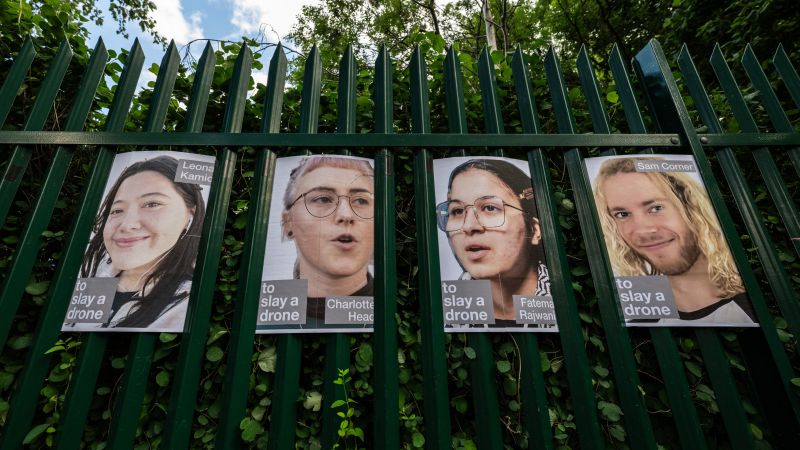
Four UK pro Palestinian activists jailed – In a landmark ruling, four British activists affiliated with the pro-Palestinian group Palestine Action have been sentenced to a combined 20 years in prison for damaging an Elbit Systems UK facility in 2024. The convictions, handed down at Woolwich Crown Court, were influenced by the judge’s determination that the attack had a “terrorism connection.” The group’s members, Charlotte Head (30), Samuel Corner (23), Leona Kamio (30), and Fatema Zainab Rajwani (21), were found guilty of criminal damage and, in Corner’s case, grievous bodily harm after a confrontation with police.
The assault occurred at Elbit’s factory in Bristol, southwest England, two years prior to the sentencing. The incident, which resulted in over £1 million in property damage, took place amid Israel’s military operations in Gaza, following a deadly Hamas attack in October 2023. Prosecutors argued that the attack should be classified as a terrorist act due to its intent to sway British government policy toward Israel and the severity of the destruction. This led to harsher penalties for the four individuals, despite their earlier acquittal on charges of aggravated burglary.
Judge Jeremy Johnson emphasized that the terrorism link was a key aggravating factor, yet he acknowledged their prior good behavior as a mitigating point. Corner, who was convicted of inflicting grievous bodily harm after striking a police officer with a sledgehammer, received a sentence of seven years and eight months. The judge noted that the force used was “extreme and gratuitous,” dismissing Corner’s autism as a justification for the attack. Kamio and Head were given five-year terms, while Rajwani received four years and eight months for the criminal damage convictions. All four will serve an additional year on probation post-release.
Legal battle over Palestine Action’s designation
Shortly after the raid, Palestine Action was proscribed under UK terrorism legislation. However, this decision was later declared unlawful by London’s High Court, though the government has yet to finalize its appeal, with a ruling expected on Monday. At the time of the offense, the group was not officially categorized as a terrorist organization, but the judge deemed the attack’s connection to terrorism significant enough to justify the extended sentences.
The activists’ legal team contested the classification, asserting that there was no foundation to treat their actions as terrorism. They were charged with criminal damage, not with specific terrorist offenses. In their defense, the group claimed their intent was to destroy weapons used in Gaza’s conflict and to halt what they called Israel’s “genocide,” while rejecting violence against individuals. Elbit, the Israeli defense firm, stated in court that it had received nearly £1.2 million from insurance to cover the damage, though the incident left a lasting effect on staff safety and morale.
“Criminal damage has never been treated as terrorism within the UK justice system before, and it is dangerous to treat them as the same thing,” said Kerry Moscogiuri, chief executive of Amnesty International UK. “It is completely disproportionate to punish protesters for criminal damage as if they were terrorists, a sentence that will stay with them for the rest of their lives.”
The prosecution highlighted the severity of the damage, which included specialist military drone equipment, IT systems, and computers. They framed the attack as part of a broader strategy to undermine Israeli military capabilities and influence British foreign policy. However, human rights advocates and notable public figures have criticized the sentences as excessive. Over 100 public personalities, including author Sally Rooney, environmental activist Greta Thunberg, and actor Steve Coogan, signed an open letter expressing concern that the terrorism label would lead to a miscarriage of justice.
Outside the courtroom, police reported that more than 100 individuals had been arrested for supporting Palestine Action, underscoring the group’s growing influence and the political tensions surrounding its activities. While the activists’ actions were seen as a direct challenge to Israel’s military operations, their supporters argue that the sentences reflect a broader trend of targeting protest groups under the guise of counterterrorism. The case has sparked debates about the balance between national security and civil liberties in the UK legal system.
Implications for future activism
The prolonged sentences have raised questions about how the UK judiciary defines terrorism in cases involving property damage. Critics contend that the legal framework allows for harsh punishments without clear evidence of intent to harm people, potentially chilling dissent. Meanwhile, the government’s continued ban on Palestine Action, despite the High Court’s ruling against its proscription, suggests a willingness to maintain strict control over the group’s activities.
As the legal battle unfolds, the activists’ fate remains a focal point for discussions on free speech and protest rights. Their convictions mark a pivotal moment in UK-Israel relations, with the court’s decision reflecting both the gravity of the attack and the political climate of the time. The case also highlights the challenges faced by organizations seeking to challenge state actions through direct intervention, even as they assert their commitment to nonviolent resistance.
In the wake of the sentencing, the UK’s approach to classifying protest as terrorism has come under scrutiny. With the four activists now serving lengthy prison terms, the question of whether their actions meet the criteria for a terrorist act continues to divide legal experts and activists alike. The ruling underscores the complexities of defining terrorism in a context where the line between protest and crime can be blurred, leaving a lasting impact on how similar cases are perceived and judged in the future.
