
Intel was on the brink of downfall. A twist in the AI race could boost its revival
Intel’s Struggles and a New Hope
Intel was on the brink of downfall – In March 2025, Lip-Bu Tan assumed the role of CEO at Intel, stepping into a company facing significant challenges. For years, the semiconductor giant had been grappling with its position in the rapidly evolving tech landscape, as rivals like Nvidia, AMD, and Qualcomm gained ground. The shift in market dynamics was stark: while Intel once dominated the chip industry, it now found itself sidelined, with Taiwan Semiconductor Manufacturing Company (TSMC) producing over 90% of the world’s most advanced silicon. This left Intel’s own manufacturing operations in a precarious position, struggling to keep pace with demand.
Tan’s tenure began with a clear message of urgency. During his first quarterly earnings call in April 2025, he acknowledged the need for transformation. “There are areas requiring improvement, and there are no instant solutions,” he stated, signaling a commitment to long-term change. A former executive at Cadence Design Systems, where he spent over a decade leading operations, Tan had previously honed strategies focused on efficiency and innovation. Yet, his low-profile approach since joining Intel contrasted with the high stakes of his new role.
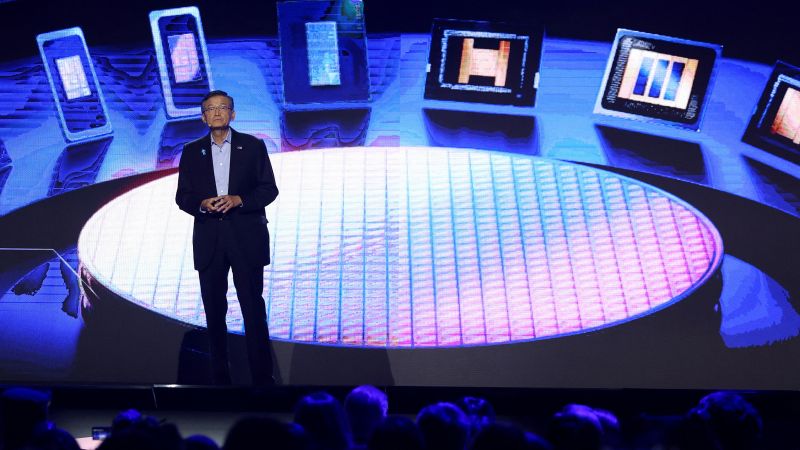
That changed when Tan delivered a keynote address at Computex, a trade show in Taipei that had surged in popularity due to the AI boom. The event drew a packed audience eager to hear about Intel’s core offerings. Central to the discussion were its central processing units (CPUs), the foundational chips that have powered computers for decades. While these chips once dominated the market, their relevance had waned as graphics processing units (GPUs) became the go-to choice for AI training. However, a surprising shift in demand has rekindled interest in CPUs, positioning them as critical to the AI revolution.
“The CPU revival could save the company,” said Dan Nystedt, a vice president at Asia-based TriOrient, in an interview with CNN. “The majority of Intel’s business remains rooted in CPUs.”
Intel’s renewed focus on CPUs stems from their role in inference—a process vital for deploying trained AI models. As companies like OpenAI, Anthropic, and Google refine their AI agents, the demand for inference-capable chips has surged. For instance, OpenClaw, a prominent AI agent that operates apps, web browsers, and smart home devices via messaging platforms like WhatsApp, relies heavily on CPUs for real-time processing. This has created an unexpected opportunity for Intel to reclaim its footing in the industry.
Analysts suggest that Intel’s turnaround could benefit immensely from this trend. “We are very focused on supply, making sure that we can delight the customer,” Tan emphasized during his Computex remarks. With a stronger financial position and a newly restructured leadership team, the company aims to capitalize on the AI-driven growth. Intel’s recent investments in engineering discipline and its efforts to align with customer needs reflect a strategic pivot toward sustainability in the market.
Competitive Shifts and Market Reactions
Nvidia, traditionally a leader in GPUs, has not been idle. At Computex, the company unveiled a new CPU line for laptops and desktops, signaling its entry into a space it once overlooked. Its Vera data center chip, now in full production, highlights the growing recognition of CPUs’ value beyond traditional graphics applications. “The CPU is now the conductor, and the GPU is the orchestra,” remarked Jensen Huang, Nvidia’s CEO, in a keynote address during the same event. This analogy underscores the evolving balance of power in the AI chip ecosystem.
Tan’s strategy at Intel mirrors his earlier playbook at Cadence. By streamlining operations and flattening corporate hierarchies, he has reoriented the company’s culture. Over the past year, he has cut approximately 34% of Intel’s workforce, halting expansion plans in Germany and Poland, and redirecting resources toward core competencies. These moves have allowed for greater agility, with Tan now personally overseeing engineering reports and maintaining closer ties to the company’s operations.
Intel’s leadership has also undergone a notable transformation. The firm has recruited senior executives from Qualcomm and Arm to lead its data center and AI divisions, bringing fresh expertise to the table. Additionally, partnerships with firms like Nvidia and Softbank have bolstered Intel’s financial and technological standing. These collaborations are seen as a critical step in positioning Intel to compete effectively in the AI-driven market.
Tan’s emphasis on engineering discipline has resonated with investors. In a statement to CNN, Intel highlighted its commitment to a stronger balance sheet, refreshed leadership, and a renewed focus on quality manufacturing. “With these elements in place, Intel is positioned to capture the AI-driven growth opportunities,” the company added. Analysts believe that if Intel can scale production efficiently and meet rising demand, its fortunes may begin to reverse.
Rebuilding Trust and Reimagining the Future
Intel’s revival hinges on its ability to adapt to changing market demands. The shift toward inference-based tasks has opened new avenues for CPUs, challenging the assumption that GPUs would dominate the AI landscape. As Tan noted, the increased interest from CEOs in CPUs over the past month reflects a growing acknowledgment of their role in powering the next wave of AI applications. “We really got excited,” he said, highlighting the optimism surrounding Intel’s potential resurgence.
While the competition remains fierce, Intel’s strategic adjustments offer a glimmer of hope. By prioritizing engineering excellence and leveraging its historical strengths, the company is seeking to redefine its position in the semiconductor industry. The combination of streamlined operations, targeted investments, and a renewed customer-centric approach has set the stage for a potential comeback. As the AI race intensifies, the question remains: can Intel’s focus on CPUs be enough to reclaim its place as a market leader?
Tan’s leadership has been characterized by decisive action. His decision to divest non-core assets and bring in external talent underscores a commitment to innovation and efficiency. By reducing layers of bureaucracy and elevating engineers to key decision-making roles, Intel is fostering a more dynamic and responsive organization. These changes are not just about survival—they are about positioning the company as a central player in the future of AI technology.
As the AI landscape continues to evolve, Intel’s journey serves as a case study in adaptability. The company’s ability to navigate the challenges of the past and seize the opportunities of the present will determine its success in the years ahead. With a renewed focus on CPUs and a leadership team ready to drive change, Intel may yet prove that it can turn its fortunes around, thanks to the pivotal role of artificial intelligence in reshaping the tech industry.
