
Kim Jong Un is loving North Korean women’s soccer. What drives its remarkable success?
Kim Jong Un is Loving North Korean Women’s Soccer. What Drives Its Remarkable Success?
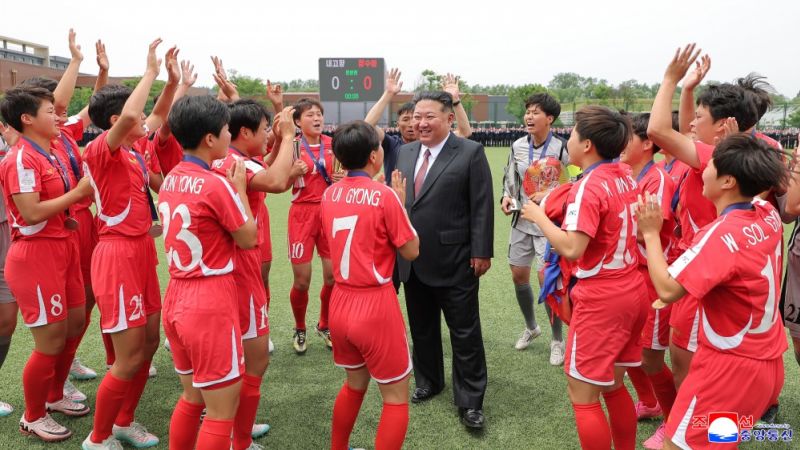
Kim Jong Un is loving North – North Korea’s women’s football team has become a global sensation, with its achievements sparking curiosity about the nation’s secretive sports strategies. The recent triumph of Naegohyang Women’s FC in the Asian Champions League, held in South Korea, marks a significant milestone for the reclusive country. This victory, achieved on foreign soil, adds to their legacy as reigning champions in under-17 and under-20 women’s soccer. The success has not gone unnoticed by Kim Jong Un, who personally celebrated the win, surrounded by players who expressed their emotions openly during the ceremony.
A Celebration of National Pride
At a recent exhibition match in Pyongyang, the team’s captain, Kim Kyong Yong, faced off against the under-17 squad, which had just secured an Asian Cup title. The event, held under the watchful gaze of the supreme leader, highlighted the nation’s commitment to showcasing its athletic prowess. Despite their young age, the under-17 players demonstrated a level of skill that stunned opponents, including Japan, whom they defeated 5-1 in the final. The celebration underscored the pride North Korea takes in its female athletes, who are often referred to as “trustworthy women” and “proud daughters of the motherland.”
“Although our players still lack experience in senior-level international competitions, they have grown significantly as a team,” Kim said after winning the Most Valuable Player award in this year’s Champions League. “Through this competition, we will work hard to overcome our shortcomings and achieve strong results in future world-class competitions.”
The Korean Central News Agency (KCNA) emphasized that the Naegohyang players attribute their success to the “loving care and benevolence of the respected Comrade Kim Jong Un.” This sentiment reflects the leader’s role in fostering a sports culture that prioritizes discipline and national honor. For many athletes, the path to international recognition begins in the Pyongyang International Football School, established in 2013 to align with Kim’s vision of athletic excellence. The academy trains hundreds of girls and boys aged 7 to 17, preparing them for national representation in various competitions.
From Youth Academies to Global Stages
Kim Kyong Yong’s journey is emblematic of the system’s effectiveness. The captain, who scored the decisive goal against Japan’s Tokyo Verdy in the Champions League final, has been a product of the rigorous development program. Her career, spanning over a decade, began at the football school and led her to represent her country at international levels. Similarly, Han Kwang Song, a forward for the men’s national team, honed his skills in the same institution before playing in Italy. His brief stint abroad before returning to North Korea illustrates the talent being cultivated within the nation’s sports infrastructure.
While the country’s isolation makes it challenging to fully understand the driving forces behind its women’s soccer success, insights from coaches and players offer a glimpse. The North Korean media report that elite academies are now integrating advanced sports science techniques, analyzing matches from overseas to refine their approach. This combination of traditional training and modern methods has created a unique environment where physicality and technical skill are cultivated simultaneously.
Physical Toughness and Technical Precision
Stephen Constantine, a British coach invited to train North Korean coaches in 2018, praised the nation’s athletes for their relentless work ethic. “When you look at the North Korean teams, the thing that impresses you the most is how aggressive and hard-working they are,” he told CNN. Constantine, who now manages Rwanda’s men’s national team, described a peculiar training method where players would piggyback one another—running from the goal line to the 18-yard line with a teammate on their back, drop her, and then sprint to the other end. “It was insane,” he added, highlighting the intensity of the regimen.
Despite their physical dominance, coaches acknowledge that technical and tactical development remains a challenge. Colin Bell, a former South Korean women’s national team manager, noted that the U20 squad’s discipline and mastery of “simple” sequences were standout features. “It’s not rocket science, but it’s very well executed, and their football IQ is very high for those age groups,” Bell said. The uniformity in players’ movement and execution, he observed, suggests a highly structured training system designed to maximize efficiency.
A System Built for Excellence
North Korea’s sports programs are often viewed as a blend of strict discipline and innovative strategies. The Pyongyang International Football School, a cornerstone of this system, is tasked with identifying and nurturing young talent. Coaches there emphasize repetition and precision, ensuring players internalize techniques that align with the country’s broader goals. This approach has yielded results, with the women’s teams consistently outperforming their rivals in regional competitions.
However, the success of these teams is not without its complexities. While the nation’s ability to produce skilled athletes is evident, the lack of transparency surrounding their methods makes it difficult to assess their full impact. South Korea’s Unification Ministry reports that Kim Jong Un has re-committed to developing athletic talent as a tool for international diplomacy. By showcasing achievements in sports, the regime aims to project an image of strength and progress, even as it maintains its reclusive stance.
Looking Ahead to the World Stage
With the Women’s World Cup in Brazil approaching, North Korea’s players are eyeing global glory. The recent Asian Champions League victory has bolstered confidence, but the team faces formidable opponents in the upcoming tournament. Analysts speculate that the country’s focus on physicality and disciplined play could translate into success on the world stage. For Kim Kyong Yong, the next chapter will be a test of endurance and adaptability, as she transitions from club to international competition.
Despite the challenges, the North Korean system has proven its ability to produce world-class athletes. The integration of foreign expertise, combined with a national emphasis on unity and perseverance, has created a pathway for young players to thrive. As the world watches their progress, the question remains: how will this tradition evolve in the face of global competition and changing dynamics in women’s soccer?
The journey of North Korea’s women’s teams is a testament to the power of strategic investment in sports. By focusing on elite development and leveraging their unique training methods, the country has carved out a niche in international football. Whether this momentum will translate into sustained success depends on their ability to balance tradition with innovation. For now, the celebration of their achievements serves as a reminder of the importance of leadership in shaping national sporting identities.
As the world continues to marvel at North Korea’s accomplishments, the athletes themselves remain a central figure in this narrative. Their stories, shaped by years of rigorous training and unwavering dedication, reflect a system that values both individual excellence and collective triumph. With the spotlight on their next challenge, the future of North Korean women’s soccer promises to be as dynamic as its past.
