
Bumblebees show advanced problem-solving skills in new experiment
Bumblebees Show Advanced Problem-Solving Skills in New Experiment
Bumblebees show advanced problem solving skills – More than a century ago, German psychologist Wolfgang Köhler conducted groundbreaking research that reshaped scientific views on animal intelligence and the concept of insight. His experiments with chimpanzees revealed that these primates could solve problems through sudden understanding rather than trial and error, a cognitive leap that fascinated researchers. Köhler designed an environment resembling a playground for the chimps, featuring a banana dangling out of reach and tools like boxes, poles, and sticks scattered nearby. The animals’ ability to stack boxes and use them to access the reward demonstrated a level of abstract thinking previously thought to be exclusive to humans. This study laid the foundation for understanding how insight differs from basic problem-solving, sparking debates about its presence in other species.
Revisiting the Concept of Insight
Insight, as defined by Köhler, involves recognizing cause-and-effect relationships without prior experience or copying others. Unlike routine problem-solving, which relies on learned patterns, insight requires an animal to grasp a solution spontaneously. This ability has been documented in only a few species, including great apes, elephants, and certain birds. However, the question of whether invertebrates like octopuses or spiders could exhibit similar behaviors remains a topic of discussion in the scientific community. Recent discoveries have begun to challenge this notion, revealing that even tiny insect brains may harbor complex cognitive capacities.
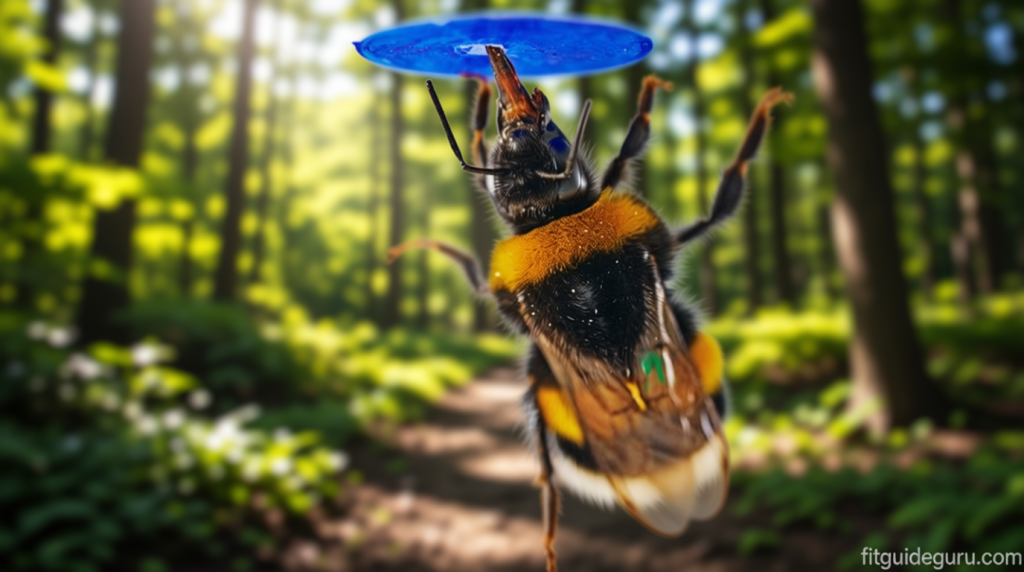
The latest research, published in *Science*, suggests that bumblebees might possess insight. In a controlled lab experiment, the insects were tasked with navigating a novel challenge involving object manipulation. The study’s lead author, Akshaye Bhambore, a doctoral researcher at the University of Oulu in Finland, explained that the bees were able to roll a plastic foam ball under an artificial blue flower to access a sugary reward. This behavior was not merely repetitive but showed an understanding of how to use the ball as a tool to reach the flower, even when the setup required strategic adjustments.
The Experimental Setup
To test the bees’ cognitive abilities, researchers constructed a circular arena measuring 10 centimeters in diameter and 3.2 centimeters in height. This confined space allowed the insects to walk but not fly, ensuring they focused on the task at hand. At the center of the arena was an artificial blue flower containing a sugary solution, while a small foam ball was placed nearby to acclimate the bees to the object. The first phase of the experiment involved letting the bees explore the setup, observing their natural interactions with the flower and the ball.
In the second scenario, the ball was positioned to cover the flower, forcing the bees to push it aside to access the reward. The insects successfully navigated this obstacle, indicating an ability to adapt their behavior based on the environment. The third and most critical scenario introduced a twist: the flower was moved from the floor to the ceiling, just above one of four pits designed to hold the ball. This setup required the bees to roll the ball to the correct pit and climb onto it to retrieve the food. Remarkably, 75% of the bees that had previously encountered the ball and flower managed this task without direct training, showcasing spontaneous problem-solving.
Interestingly, bees from two control groups—those unfamiliar with the ball and those only exposed to the flower—struggled to solve the puzzle. This contrast highlighted the importance of prior experience in shaping the insects’ ability to apply insight. “We wanted to know how much previous information they needed in order to solve the task,” said study coauthor Olli Loukola, a behavioral ecologist. The results suggest that bumblebees can process abstract spatial relationships and use objects purposefully, traits once considered advanced for animals of their size.
Implications for Insect Cognition
James Nieh, a professor at the University of California San Diego, emphasized the significance of the findings. “This study demonstrates that a tiny insect brain can support surprisingly flexible behavior,” he stated in an email. While bees do not typically move objects to create platforms in the wild, the experiment revealed their capacity to manipulate objects in relation to a goal. This adaptability could have profound implications for how bees interact with their environment, particularly in changing ecosystems.
Natalie Hempel de Ibarra, an associate professor of neuroethology at the University of Exeter, noted the broader impact of the research. “This exciting new study shows that insects can learn and change their behavior in ways scientists are only just starting to understand,” she wrote. The ability of bees to adjust their strategies in response to new challenges may influence their role as pollinators, helping them navigate shifting floral landscapes. Such findings could also inspire advancements in robotics and artificial intelligence, where mimicking insect cognition offers unique advantages.
Expanding the Frontiers of Animal Intelligence
The study not only redefines our understanding of bumblebee intelligence but also raises questions about the evolution of cognitive abilities across species. If insects can demonstrate insight, it challenges the assumption that such mental processes are limited to vertebrates. Researchers are now exploring whether other invertebrates, like ants or wasps, might also exhibit similar problem-solving skills. This work could bridge gaps between different animal groups, revealing shared mechanisms of learning and adaptation.
While the results are compelling, some scientists remain cautious. The experiment’s design required careful control to eliminate external variables, and further studies are needed to confirm the bees’ ability to solve tasks independently. Nonetheless, the findings open new avenues for research, suggesting that animals with small brains may have more complex cognitive tools than previously believed. As the study underscores, the capacity for insight is not confined to large-brained species, but rather represents a universal trait that can manifest in diverse forms across the animal kingdom.
Scientists are now working to decode the neural processes that enable such behaviors. The study highlights the importance of environmental complexity in fostering cognitive growth, even in species with minimal brain size. By observing how bumblebees tackle challenges, researchers gain insights into the fundamental principles of learning and memory. These discoveries may one day lead to better conservation strategies for pollinators, as understanding their cognitive abilities can inform how we design habitats and manage ecosystems. The implications extend beyond biology, touching on philosophy and the very definition of intelligence itself.
In conclusion, this experiment marks a pivotal moment in animal cognition research. By demonstrating that bumblebees can solve novel problems through insight, the study challenges existing paradigms and expands the scope of what we consider intelligent behavior. As more research is conducted, the line between human and animal cognition may blur, revealing a shared evolutionary heritage of problem-solving. The work also invites reflection on how we interact with nature, suggesting that even the smallest creatures may hold answers to some of the most complex questions in science.
