
Sudan war: Why Hemedti’s legitimacy push in Uganda falters amid RSF atrocities
Sudan War: Why Hemedti’s Legitimacy Push in Uganda Falters Amid RSF Atrocities
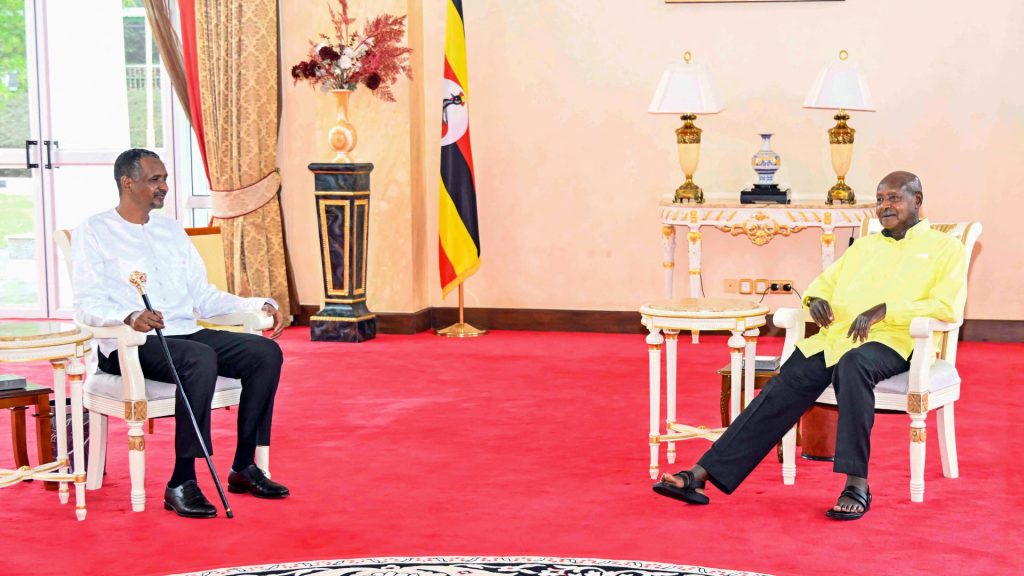
On February 20, Mohamed Hamdan Dagalo, widely known as Hemedti, traveled to Kampala, Uganda, where he met with President Yoweri Museveni. The visit marked Hemedti’s most prominent diplomatic outreach beyond Sudan’s borders in recent months.
Just a day after a UN investigation uncovered genocide allegations against the RSF in Darfur, the U.S. imposed sanctions on three RSF commanders for their role in atrocities in el-Fasher. This followed months of international criticism of RSF actions, including a December 2023 U.S. ruling that RSF conduct in Darfur constituted ethnic cleansing, alongside resolutions and briefings at the UN Security Council throughout 2024.
Hemedti did not arrive solo. He was accompanied by individuals connected to the political framework he established in Nairobi, referred to as “Tasis,” which aimed to present RSF-controlled regions as a civilian-backed administrative model. Despite its intent, the initiative failed to gain widespread Sudanese political support and was largely rejected by governments, regional bodies, and international organizations, including the UN.
Sudan’s ruling government criticized Uganda for welcoming Hemedti, framing the move as an insult to the Sudanese people and humanity. The invitation to Kampala thus represents more than a diplomatic gesture—it signals a recalibrated effort to secure recognition on a regional scale.
The RSF’s current administrative oversight in its territories and backing for parallel governance structures raise concerns about Sudan’s potential fragmentation. This shift highlights a central dilemma: whether the RSF can transition from a paramilitary force to a politically legitimate entity without compromising its military autonomy.
Hemedti’s visit reflects a calculated strategic pivot. No longer confined to combat zones or domestic audiences, he seeks regional influence to shape narratives, build alliances, and assert authority beyond national borders. In Kampala, he emphasized national unity, opposition to partition, and a commitment to dialogue, framing the conflict as a battle against entrenched Islamist networks while positioning himself as open to civilian-led political processes.
His address included claims of military strength, stating that RSF fighters now number over 500,000 and are fully prepared to play a broader role in Sudan’s future. This assertion appears designed to bolster internal support, reassure allies, and signal readiness to negotiate on equal terms.
Yet, the situation reveals a stark contradiction. A commander of a force accused of mass abuses internationally now advocates democracy while leading a parallel political apparatus outside recognized state institutions. The test here extends beyond Hemedti himself, assessing the RSF’s ability to shift from military dominance to political legitimacy without surrendering military control.
Analysts at the International Crisis Group have consistently warned that Sudan’s conflict is no longer solely about Khartoum but revolves around competing sovereignty claims. Prolonged dual-authority dynamics in African conflicts often harden into lasting fragmentation, as seen in other regional disputes.
Uganda’s selection as a host was strategic. Museveni has long positioned himself as an advocate of “African solutions to African problems,” and the country occupies a neutral position within the Horn and East African diplomatic landscape. Hosting Hemedti elevates Kampala’s role as a potential mediator without tying it to a single Sudanese faction.
The visit also connects to broader mediation frameworks involving the African Union and the Intergovernmental Authority on Development (Igad). However, by engaging Hemedti publicly, Museveni enters a delicate balancing act, navigating support for the RSF while maintaining relations with Sudan’s government.
