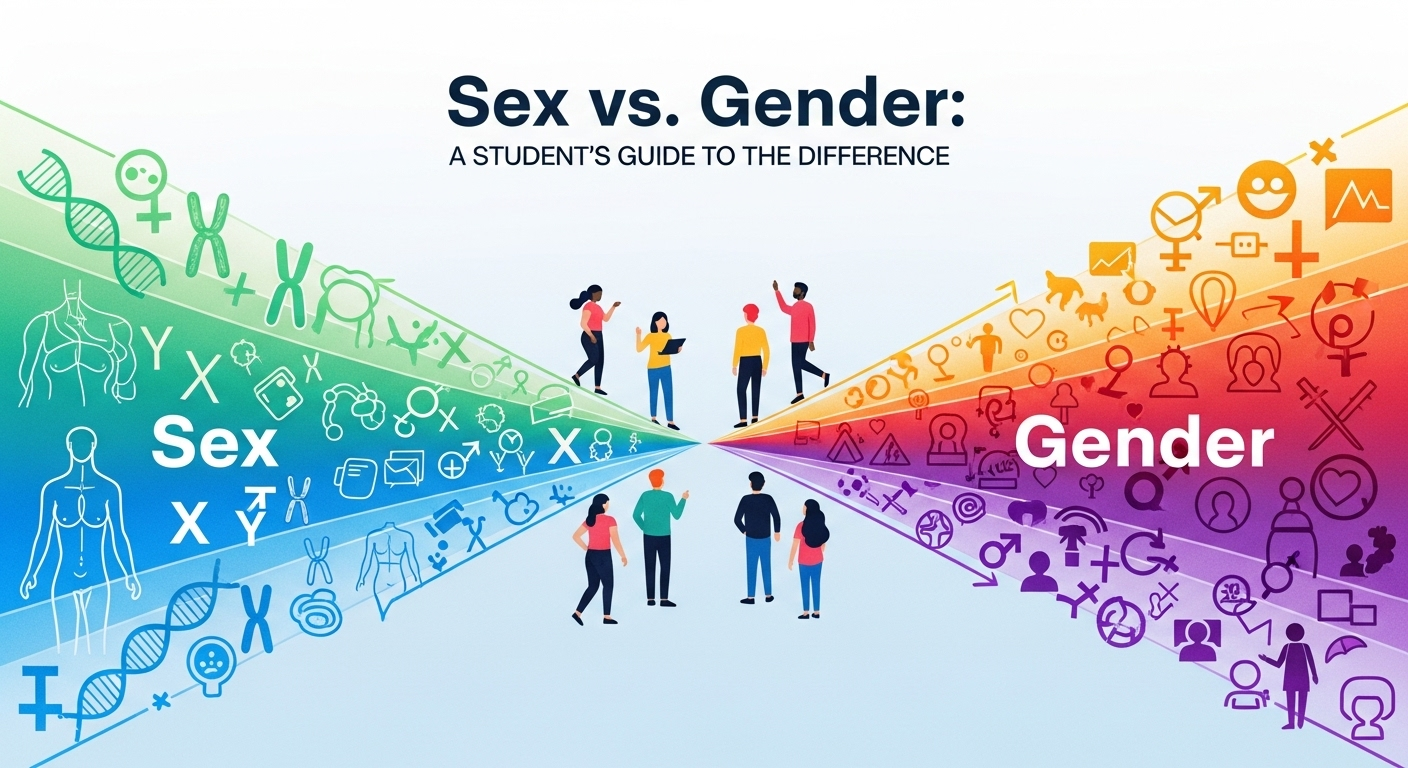
Cisgender***: This term describes a person whose gender identity aligns with the sex they were assigned at birth. For example, a person who was assigned female at birth and identifies as a woman is cisgender. The prefix "cis-" is Latin for "on the same side as."<strong>Transgender*: This is an umbrella term for people whose gender identity differs from the sex they were assigned at birth. For instance, someone assigned male at birth who has an internal sense of being a woman is a transgender woman. The prefix "trans-" is Latin for "on the other side of."<strong>Non-Binary: This is another umbrella term for gender identities that are not exclusively masculine or feminine—identities which are outside the gender binary. This can include people who identify as both a man and a woman, neither a man nor a woman (agender), or whose gender identity fluctuates (genderfluid*). Gender Expression: How You Show Your Gender to the World Gender expression is the outward manifestation of gender. This includes the way you dress, your haircut, the way you speak, your mannerisms, and the pronouns you use (like he/him, she/her, or they/them). It is everything you do to communicate your gender identity—or to simply be yourself—in the world. Importantly, your gender expression is entirely your own and does not have to "match" stereotypical expectations. A man can enjoy wearing dresses and makeup, and a woman can have short hair and prefer wearing suits. It is crucial to remember that gender expression does not necessarily equal gender identity. You cannot know someone’s gender identity simply by looking at them. For example, a man who enjoys traditionally "feminine" clothing (expression) is still a man if he identifies as one (identity). Assuming someone's gender based on their appearance can be hurtful and invalidating. The most respectful approach is to never assume and to listen to how people describe themselves. The freedom to express one's gender in a way that feels authentic is a vital part of personal well-being and self-acceptance. The Spectrum of Gender: Beyond the Binary For a long time, many societies have operated on a gender binary, the idea that there are only two genders—man and woman—and that every person fits into one of these two boxes. However, this is an oversimplified and often inaccurate view of human experience. Just as sex isn't a strict binary (as shown by intersex individuals), gender is also more accurately understood as a spectrum. There is an infinite range of gender identities, and many people do not identify strictly as a man or a woman. Embracing the concept of a gender spectrum means acknowledging identities that exist outside the traditional binary. These are often grouped under the non-binary umbrella. Some of these identities include: Agender: A person who does not identify with any gender. Bigender: A person who identifies with two genders, either at the same time or fluctuating between them. Genderqueer: An umbrella term for people who don't subscribe to conventional gender distinctions but identify with neither, both, or a combination of male and female genders. Genderfluid: A person whose gender identity is not fixed and can change over time. These labels can be incredibly empowering for individuals who feel they don't fit into the "man" or "woman" category. They provide language to describe an internal feeling that might have previously been confusing or isolating. At the same time, it's important to remember that not everyone will use a specific label. The ultimate goal is not to force everyone into a new set of boxes, but to create a world where all identities are seen, respected, and affirmed, whether they come with a label or not. The key is to listen to and respect how each individual self-identifies. Sex, Gender, and Social Roles: Deconstructing Stereotypes Beyond identity and expression, our understanding of gender is heavily influenced by gender roles. These are the social and behavioral norms that a given society considers appropriate for men and women. They are not based on biology; rather, they are sets of expectations that are learned from our parents, teachers, media, and culture. These roles dictate everything from the toys we are given as children to the careers we are encouraged to pursue as adults. Think about some common stereotypes: "boys don't cry," "girls are better at nurturing," or "men are breadwinners." These are all examples of gender roles. They create a prescriptive script for how we should behave based on our gender. While some of these roles might seem harmless on the surface, they can be incredibly limiting. They restrict individual potential by discouraging people from pursuing interests or expressing emotions that fall outside their assigned gender's "rules." For example, a boy who loves to dance might be bullied, or a girl who is assertive might be called "bossy." Challenging and deconstructing these rigid gender stereotypes is beneficial for everyone, regardless of their gender identity. When we let go of the idea that boys must be a certain way and girls must be another, we create more freedom for all individuals to be their authentic selves. It allows people to explore their full range of emotions, talents, and interests without fear of judgment. This ultimately leads to a more equitable and innovative society where people are valued for who they are, not for how well they conform to outdated expectations. The Importance of Language: Pronouns and Respectful Communication Language is incredibly powerful. The words we use have the ability to either validate and respect someone's identity or to erase and invalidate it. In conversations about gender, one of the most important and straightforward ways to show respect is by using a person's correct pronouns. Pronouns are the words we use to refer to someone in the third person, such as "he," "she," or "they." Using someone's correct pronouns is a fundamental way of acknowledging that you see them for who they are. While many people use the pronouns that might be expected based on their appearance (e.g., she/her for someone who looks like a